

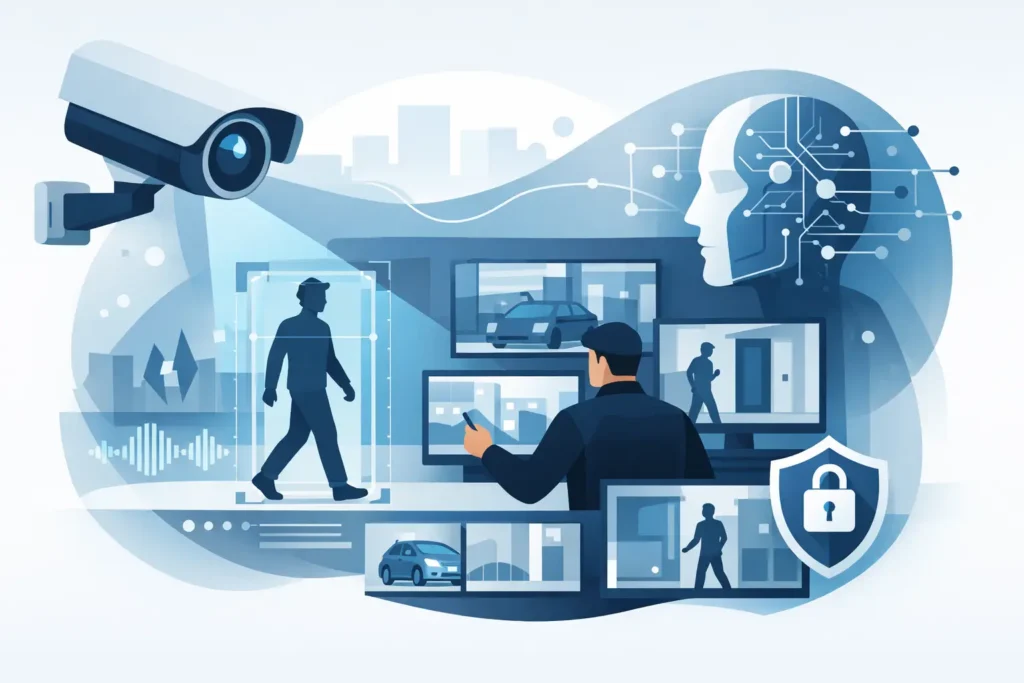
A camera recording an incident after the fact can provide useful evidence. A security system that identifies a person entering a restricted area, a vehicle stopping at a loading dock after hours, or a crowd forming near an entrance can help your team act while the situation is still developing. That is the practical value of AI video analytics for security.
For property owners, business operators, and facilities managers, the goal is not simply to add more cameras. It is to gain meaningful awareness of what is happening across a property, reduce unnecessary alarms, and ensure the right people receive actionable information quickly. When AI analytics are paired with professional monitoring, access control, alarms, and trained security personnel, video becomes part of an active protection program.
What AI Video Analytics for Security Actually Does
AI video analytics uses software to interpret video footage from security cameras. Rather than treating every movement in a scene as equal, the system can be configured to recognize defined events, such as a person crossing a virtual boundary, a vehicle entering a designated zone, an object being removed, or activity occurring outside normal operating hours.
This does not mean the technology replaces professional judgment. It helps focus attention where it is needed. A monitoring professional or onsite security team can review a verified alert, assess the context, and follow the response procedures established for the property.
For example, motion detection alone may trigger an alert when rain moves a sign, headlights sweep across a parking lot, or an animal passes through a perimeter. AI-enabled analytics can distinguish between people, vehicles, and other movement patterns. That filtering can reduce false alarms and help security teams spend less time reacting to routine activity.
From Recorded Footage to Active Awareness
Traditional CCTV systems are often used reactively. After a theft, trespass, or workplace incident, someone reviews hours of recorded video to determine what happened. High-quality footage remains essential for investigations, accountability, and insurance documentation, but it should not be the only role a camera system plays.
AI analytics can make surveillance more proactive. It can send an alert when a person approaches a secured gate, when a vehicle remains in a no-parking area, or when activity occurs in an area that should be empty. The exact functions depend on the cameras, lighting, site layout, and the rules configured for the location.
This shift is especially valuable for properties with limited staff after hours. Warehouses, construction sites, retail locations, office buildings, residential communities, and industrial facilities can all benefit from earlier awareness of unusual activity.
Where AI Analytics Delivers the Most Value
The strongest security programs begin with the risks specific to the site. A retail operation may need support with shoplifting, employee-only areas, and closing procedures. A commercial property may be focused on unauthorized access, vandalism, and parking-lot safety. An industrial site may need to monitor gates, equipment storage, loading areas, and wide perimeter zones.
AI analytics can be configured around those priorities. Common applications include line-crossing alerts at fences and doors, intrusion detection in restricted zones, people and vehicle classification, loitering detection, occupancy awareness, and object-related alerts. In certain settings, analytics can also help identify unusual activity at entry points or support faster searches through recorded footage after an event.
The technology is most effective when each alert has a purpose. If every camera sends notifications for ordinary activity, staff may begin ignoring them. A carefully designed system uses focused rules, appropriate schedules, and priority levels so that alerts support a clear response plan.
Protecting Operations, Not Just Property
Security events can disrupt more than physical assets. A break-in may delay opening hours. Unauthorized access can create safety concerns. A dispute at a workplace entrance may affect employees, visitors, and business continuity. Clear video and timely alerts give decision-makers better information when they need it.
For organizations managing sensitive events, labor disputes, or high-profile visits, video analytics can also support situational awareness. It can help security personnel observe approach routes, restricted areas, and crowd movement without relying entirely on constant manual camera viewing. Human teams remain responsible for de-escalation, communication, and response, while technology helps them see developing concerns sooner.
Why Integration Matters
A camera system delivers more value when it works alongside other protective measures. An AI alert may prompt a remote monitoring center to review live video, contact a designated representative, dispatch a guard, or follow an escalation protocol. If a door alarm, access-control event, and camera alert occur at the same time, the combined information can provide a clearer picture than any one system alone.
Integration also improves accountability. A facility manager can review whether a door was opened with a valid credential, whether someone entered after the door was forced, and what occurred in the surrounding area. This can support incident reporting, internal investigations, and ongoing improvements to site procedures.
Maritect Investigations & Security Limited designs integrated programs that bring video analytics, alarms, access systems, remote monitoring, and protective services together based on each client’s environment and risk profile. The right approach may be a small, focused system for a single location or a scalable program across multiple sites.
Installation Quality Affects Results
AI analytics are not a set-it-and-forget-it feature. Camera placement, field of view, lighting, network reliability, and system maintenance all affect performance. A camera pointed too high may not capture the detail needed to distinguish people from objects. Poor nighttime lighting can limit detection accuracy. A busy sidewalk beside a restricted area may require careful zone configuration to avoid constant alerts.
Before installation, a proper assessment should consider entry and exit points, high-value assets, blind spots, traffic patterns, operational hours, and how staff will respond to alerts. After installation, the system should be tested and adjusted as the property changes. Seasonal conditions, construction, landscaping, and altered workflows can all affect how a camera scene performs.
The Trade-Offs to Consider
AI video analytics is powerful, but it is not a guarantee that every incident will be prevented. It works best as one layer within a broader security plan. Cameras cannot physically stop an intruder, and an alert only helps if someone receives it, verifies it, and takes appropriate action.
Privacy also deserves careful attention. Organizations should use cameras and analytics for legitimate security purposes, post required notices, limit access to footage, and establish retention practices that align with their obligations. Analytics should be configured to protect people and property without creating unnecessary surveillance of areas where privacy is expected.
There is also a balance between sensitivity and relevance. A system set to alert on every movement may create too much noise. A system set too narrowly may miss events that deserve review. The right settings depend on the environment, risk level, and available response resources.
Building a Response-Ready Security Program
Start by identifying the events that would most affect your people, assets, and operations. Consider what happens after hours, where unauthorized access is most likely, and which locations are difficult for staff to observe. Then decide who needs to receive alerts and what they should do when an alert is verified.
A practical response plan may involve remote video review, a call to a keyholder, an onsite guard response, law enforcement notification when appropriate, or documentation for follow-up. The plan should be clear enough that people are not deciding from scratch during a stressful event.
AI video analytics is most valuable when it gives your team time, clarity, and options. With professional design, dependable monitoring, and a response process that fits your operation, your cameras can do more than record what happened. They can help protect what matters while there is still time to act.
