

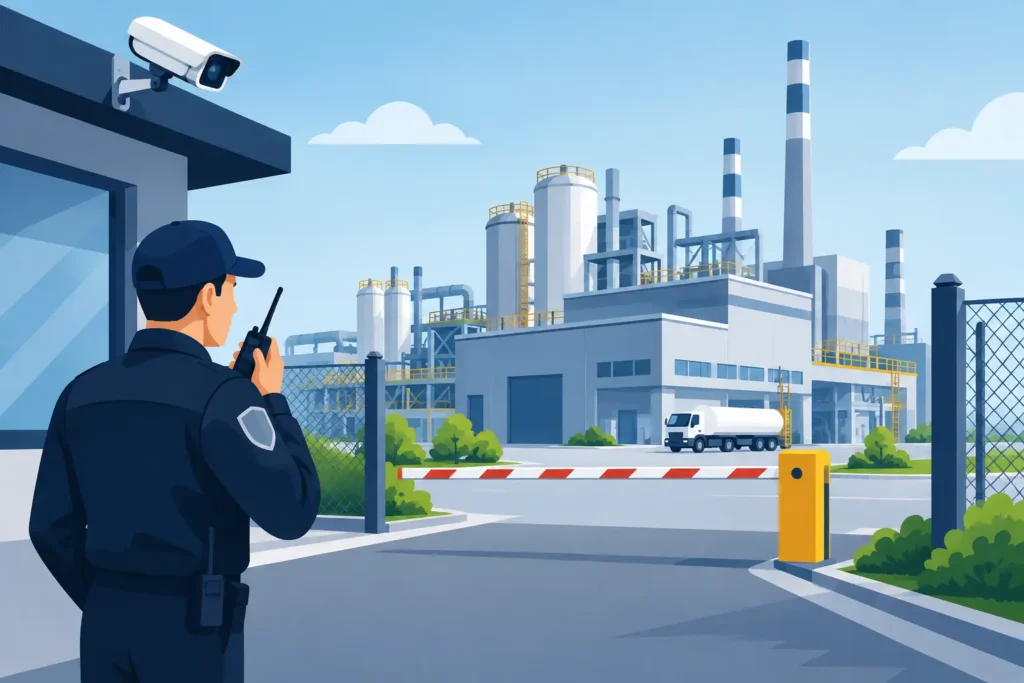
A loading gate left open after a late shipment, a contractor using an unreturned access card, or a camera pointed at the wrong part of the yard can become more than a minor security gap. At an industrial facility, one unnoticed event can lead to stolen materials, equipment damage, safety exposure, delayed production, and costly interruptions. Effective industrial site security gives operators clear visibility, controlled access, and a dependable response when something needs attention.
Industrial properties face a different risk profile than a typical office or storefront. They often cover large areas, operate beyond normal business hours, store high-value tools and materials outdoors, and welcome a changing mix of employees, drivers, vendors, and contractors. The goal is not simply to add cameras or put a guard at the gate. It is to build a practical security program around how the site actually operates.
Industrial Site Security Starts With the Site, Not the Equipment
A security plan should begin with a clear assessment of the property and its daily routines. A warehouse with one public entrance has different needs than a manufacturing campus with multiple gates, fleet parking, exterior storage, hazardous materials, and overnight shipping activity.
Start by identifying what must be protected. This includes buildings and inventory, but it should also include loading docks, fuel storage, machinery, server rooms, employee parking, key cabinets, and perimeter fencing. Consider when each area is most exposed. A yard may be quiet overnight but highly active at shift change. A receiving area may be secure during the day yet vulnerable after a delivery is delayed.
Security teams should also look at the pathways people use. Can someone enter through an unlocked pedestrian gate and reach a storage area without being noticed? Does poor lighting make it difficult to identify a person or vehicle? Are visitors able to move from a reception area into operations without an escort? These details determine where technology and personnel will have the greatest effect.
Build Protection in Layers
The strongest programs use several connected layers of protection. If one control is bypassed or fails, another can help detect, delay, or document the event. The right mix depends on the site’s risks, budget, operating hours, and whether a live response is needed.
Perimeter and property visibility
A visible, maintained perimeter sets the first boundary. Fencing, gates, lighting, signage, and clearly marked visitor routes discourage casual trespassing and make unusual activity easier to recognize. Physical barriers alone are not enough, especially on large or remote properties, but they create valuable time for a monitoring team or onsite guard to respond.
High-definition CCTV extends that visibility across entrances, yards, loading areas, parking lots, and restricted zones. Camera placement matters more than camera count. A camera should capture useful details at the point of decision, such as a face at a door, a license plate at a gate, or activity around stored equipment. Cameras installed too high, poorly lit, or aimed only at broad open space may record an event without providing usable evidence.
AI-powered video analytics can strengthen this coverage by identifying activity that deserves attention. Depending on the system design, alerts can be triggered by a person entering a restricted area, a vehicle crossing a virtual line, loitering near equipment, or movement after hours. This helps monitoring personnel focus on meaningful events instead of sorting through hours of routine footage.
Controlled access to buildings and restricted areas
Keys are easy to copy, lose, and keep after an employee or contractor leaves. Access control provides a clearer record of who entered a space, when they entered, and whether they were authorized. Card, fob, mobile credential, keypad, and biometric options can be used based on the level of risk and the working environment.
For many sites, it makes sense to separate access by role. Office staff may need access to the main building during business hours, while maintenance personnel need scheduled access to utility rooms or equipment areas. Contractors can be given temporary credentials that expire automatically. Managers can also remove access immediately when a worker changes roles or leaves the organization.
Access systems should not create unnecessary delays during a busy shift. The best approach balances security with operations. A door that is constantly propped open because it slows down workflow is a sign the access plan needs adjustment, not simply stricter rules.
Detection and response after hours
Intrusion alarms, door contacts, motion sensors, glass-break detection, and tamper monitoring can alert a team when a secured area is breached. These tools are particularly valuable in offices, warehouses, maintenance rooms, and sites that are unoccupied overnight.
An alert only has value when someone receives it, assesses it, and follows a defined response procedure. Twenty-four-hour remote monitoring can verify activity through video, contact designated personnel, dispatch response when appropriate, and preserve an incident record. This may be more practical than staffing a guard at every location around the clock, especially for smaller facilities or properties with predictable after-hours activity.
For higher-risk sites, uniformed guards provide a visible presence, conduct patrols, manage visitors, check gates, and respond to issues that require someone on the ground. Guarding is often most effective when paired with surveillance and access data. A guard should arrive with useful information, not spend valuable time determining where an alarm originated or whether a door was forced.
Protect the Daily Movement of People and Materials
Industrial facilities depend on movement. Employees arrive for shifts, trucks enter yards, deliveries are unloaded, contractors perform work, and materials leave the property. Security should support that movement while maintaining accountability.
A documented visitor and contractor process is one of the most practical controls available. Visitors should be identified, checked in, issued the appropriate credential, briefed on site rules, and escorted where necessary. Contractors working after hours or in sensitive areas should have clear authorization, a defined scope of access, and a reliable check-out process.
Vehicle access deserves the same attention. Gate procedures, delivery schedules, plate capture, driver verification, and designated staging areas can reduce confusion at busy entrances. On facilities with valuable equipment or materials, managers may also need procedures for inspecting outgoing loads, securing trailers, and recording asset movement.
Background screening can add another layer of confidence for positions involving access to inventory, sensitive systems, keys, financial records, or vulnerable areas. Screening is not a substitute for supervision or access controls, but it helps organizations make informed hiring decisions and maintain documented procedures.
Use Technology to Improve Awareness, Not Create More Noise
Security technology should make decisions easier. If a system sends frequent false alerts, operators begin to ignore notifications. If footage is difficult to retrieve, it may not help during an investigation. If separate systems do not communicate, staff may miss the full picture of an incident.
Integrated systems bring cameras, alarms, access events, intercoms, and monitoring into a coordinated workflow. For example, an after-hours door alarm can prompt a monitoring operator to view the associated camera, confirm whether activity is authorized, and follow the site’s escalation plan. If access records show a credential was used moments before the alert, that information can help determine whether it was a scheduled entry or a concern requiring response.
Integration does require planning. Older equipment may need to be upgraded gradually, and not every location needs every advanced feature. A well-designed program prioritizes the highest-risk areas first, then expands as operational needs and budgets allow.
Turn Incidents Into Better Protection
Every alarm, access issue, theft attempt, or safety concern should be reviewed for lessons. Was the event detected quickly? Was the response clear? Did staff know who to call? Was footage available and retained long enough? Small adjustments after an incident can prevent a larger problem later.
Written procedures are especially useful for events that create pressure or confusion, including trespassing, theft, aggressive behavior, labor disputes, severe weather, or a system outage. Staff should know who has authority to make decisions, how to contact security support, and how incidents will be documented. Training should be practical and repeated when roles, layouts, or systems change.
Maintenance is part of protection as well. Cameras need clean lenses and accurate views. Gates, locks, readers, and alarm devices need testing. Access permissions need regular review. A security system that worked well at installation can lose effectiveness when a facility expands, staffing changes, or equipment is left unattended.
Maritect Investigations & Security Limited approaches industrial protection as an ongoing service, combining site-specific system design with monitoring, maintenance, and trained protective support when it is needed.
The most useful next step is to walk the property after hours and view it as an unauthorized person would. Look for the unlit corner, the unsecured side door, the blind spot near stored equipment, and the process no one owns. Those observations can turn security from a collection of devices into dependable protection for the people and operations that keep the site moving.
