

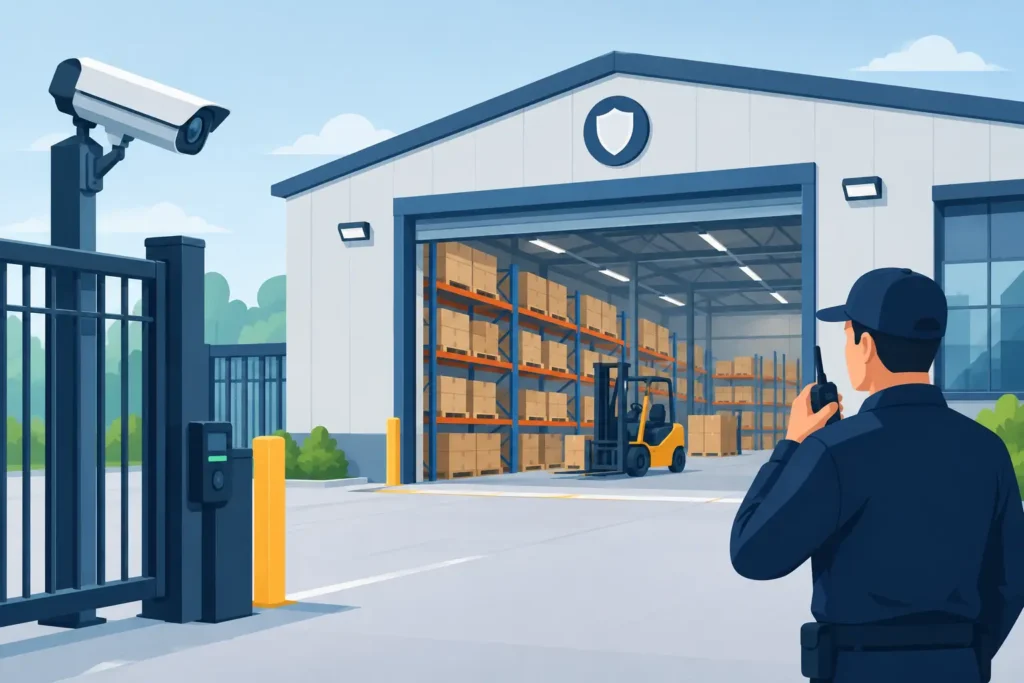
A warehouse can lose far more than inventory in a single security incident. A forced entry, unauthorized pickup, internal theft, or loading-dock breach can interrupt shipments, compromise customer trust, and leave management without the evidence needed to act. The best security measures for warehouses combine visible deterrence, early detection, controlled access, and a reliable response when something is wrong.
No two facilities carry the same risks. A small warehouse with high-value electronics needs different controls than a distribution center moving large volumes of general merchandise. The right program starts with how goods, vehicles, employees, contractors, and visitors move through the site – then protects the points where control is most likely to break down.
Start With a Warehouse Security Assessment
Security equipment is most effective when it is designed around the facility, not selected from a catalog. Begin by mapping the property perimeter, employee entrances, delivery gates, loading bays, storage zones, server rooms, key cabinets, and areas where trailers are staged. Review when each area is active and who should have access at each time of day.
This assessment should also look at operational patterns. Are drivers arriving before receiving staff? Do temporary workers move between restricted areas? Is inventory left in trailers overnight? Are keys, access cards, or handheld scanners shared? These details often reveal practical vulnerabilities that a camera alone cannot solve.
A useful assessment includes a review of prior losses, false alarms, trespassing incidents, and near misses. It should identify not only where an intruder could enter, but also how an incident would be noticed, verified, documented, and escalated. That turns security from a collection of devices into an operating procedure.
Best Security Measures for Warehouses: Build Layers
A warehouse should not depend on one control. Cameras can record an incident, but they do not physically restrict entry. A locked door helps, but it does not tell you when someone is attempting to bypass it. Layered protection closes those gaps by combining physical barriers, electronic systems, trained personnel, and response procedures.
Secure the perimeter and loading areas
Perimeter protection establishes the first visible boundary. Fencing, vehicle gates, adequate lighting, clear signage, and maintained landscaping make it harder for unauthorized people to approach unseen. Keep shrubs and stored materials away from fences, doors, and camera views. A blind corner beside a loading area can become an easy access point after dark.
Loading docks deserve special attention because they are designed for constant movement. Separate pedestrian routes from vehicle lanes where possible, control who can open dock doors, and keep trailers secured when they are not actively being loaded or unloaded. Trailer seals, lock checks, and documented custody changes add accountability where inventory is most exposed.
Lighting is a practical deterrent, but it must be placed correctly. Bright lights that glare into cameras or create deep shadows can reduce visibility. A security review can help position lighting so it supports surveillance footage, employee safety, and after-hours detection.
Use access control to limit and document entry
Traditional keys are difficult to manage in a busy facility. They can be copied, shared, or retained after an employee leaves. Electronic access control gives managers the ability to issue permissions by person, role, area, and schedule. It also creates an audit trail showing who entered a protected area and when.
Use separate access levels for office space, warehouse floors, inventory cages, IT rooms, chemical storage, and executive areas. For higher-risk zones, consider two-factor access or a second verification step. The goal is not to make routine work difficult. It is to ensure that employees and contractors can enter only the spaces they need to perform their jobs.
Access credentials should be removed immediately when employment or contracts end. Regularly review active cardholders and investigate attempts to use expired, duplicated, or unauthorized credentials. This is especially valuable for warehouses that rely on seasonal staff, third-party cleaners, drivers, or maintenance crews.
Add AI-enabled video surveillance where it matters most
High-definition cameras provide visibility, evidence, and a strong deterrent when they are positioned around real operational risks. Priority locations usually include vehicle entrances, pedestrian doors, fence lines, loading docks, shipping and receiving areas, inventory storage, cash-handling locations, and exterior parking areas.
AI video analytics can make surveillance more actionable. Instead of requiring someone to watch every camera feed continuously, analytics can identify events such as a person entering a restricted zone, a vehicle lingering at a gate, movement after hours, or an object removed from a designated area. Alerts can be sent for review so a verified issue receives attention faster.
Placement and retention matter as much as camera count. A camera mounted too high may show that an event occurred but fail to capture a usable face, license plate, or package label. Storage should retain footage long enough for managers, insurers, or investigators to retrieve it when needed. Cameras also require routine maintenance to keep lenses clean, angles correct, and recording functions operational.
Connect intrusion alarms to 24/7 monitoring
An intrusion alarm adds immediate detection when the facility is closed or lightly staffed. Door contacts, glass-break sensors, motion detection, and tamper monitoring can protect entry points and sensitive interior areas. The system should be programmed around the warehouse schedule so authorized activity does not create repeated false alarms.
Professional monitoring provides an additional layer when onsite staff are unavailable. A monitoring center can assess alarm signals, follow established contact procedures, and coordinate an appropriate response. For many operations, remote monitoring of video and alarms provides stronger coverage than relying on a manager to notice a notification on a phone at 2:00 a.m.
False alarms are a real trade-off. They can drain resources and reduce confidence in the system. Clear arming procedures, properly configured sensors, staff training, and prompt maintenance help keep alerts meaningful.
Put People and Procedures Behind the Technology
Technology is powerful, but warehouse security still depends on consistent human decisions. Employees should understand visitor rules, badge expectations, reporting procedures, and the importance of challenging unfamiliar people in restricted areas through appropriate channels. They should also know not to prop doors open for convenience or allow tailgating through controlled entrances.
Visitor and contractor management should be simple enough to follow every day. Require sign-in, issue visible identification, document the host, and limit access to the necessary areas. For higher-risk sites, background screening and pre-authorization may be appropriate before granting access to inventory, systems, or sensitive records.
Uniformed security officers can be valuable during high-risk periods, labor disruptions, construction projects, special shipments, or recurring trespass issues. Their presence provides visible deterrence while giving the site an immediate point of contact for patrols, access enforcement, incident reporting, and escalation. The best fit depends on risk, hours of operation, site size, and the level of response required.
Written procedures should cover lost credentials, suspicious packages, theft allegations, workplace violence concerns, fire exits, after-hours deliveries, and emergency contacts. Keep them practical and test them. A plan that has never been exercised often fails when a real incident creates pressure.
Protect Inventory With Accountability, Not Suspicion
Internal loss can be difficult to address because warehouses depend on trust, speed, and teamwork. Effective controls focus on accountability rather than treating every employee as a suspect. Use documented receiving and shipping processes, reconcile inventory variances quickly, and restrict access to high-value stock.
Cameras can support investigations when they are paired with transaction records, access logs, and shipping documentation. If a discrepancy occurs, managers can compare the time of the transaction with relevant video and access activity. This approach produces clearer facts and helps avoid assumptions.
For valuable or regulated goods, consider secured cages, controlled key systems, dual verification for removal, and periodic audits. The right level of control depends on the value, portability, and resale risk of the product. A pallet of low-value packaging materials does not require the same protection as pharmaceuticals, electronics, tools, or controlled substances.
Maintain the System and Measure What Changes
Security is not finished after installation. Cameras, alarms, locks, gates, lighting, and access-control readers need inspection and maintenance. Review system health reports, test backup power, replace damaged signs, update user permissions, and correct camera obstructions before they become a problem.
Track incidents and trends over time. Repeated door alarms, access denials, fence-line activity, and inventory discrepancies can indicate a process problem that deserves attention. Security reporting helps leaders make informed decisions about where to adjust procedures, add coverage, or invest in stronger controls.
Maritect Investigations & Security Limited designs integrated programs that bring surveillance, access control, alarm monitoring, and protective services together around the way a property actually operates. The objective is dependable awareness and a response plan that does not leave your team guessing.
A warehouse is safest when protection supports the pace of the operation rather than fighting it. Start with the vulnerabilities that could cause the greatest loss, assign clear ownership for every alert and access point, and build a program your staff can follow with confidence every shift.
