

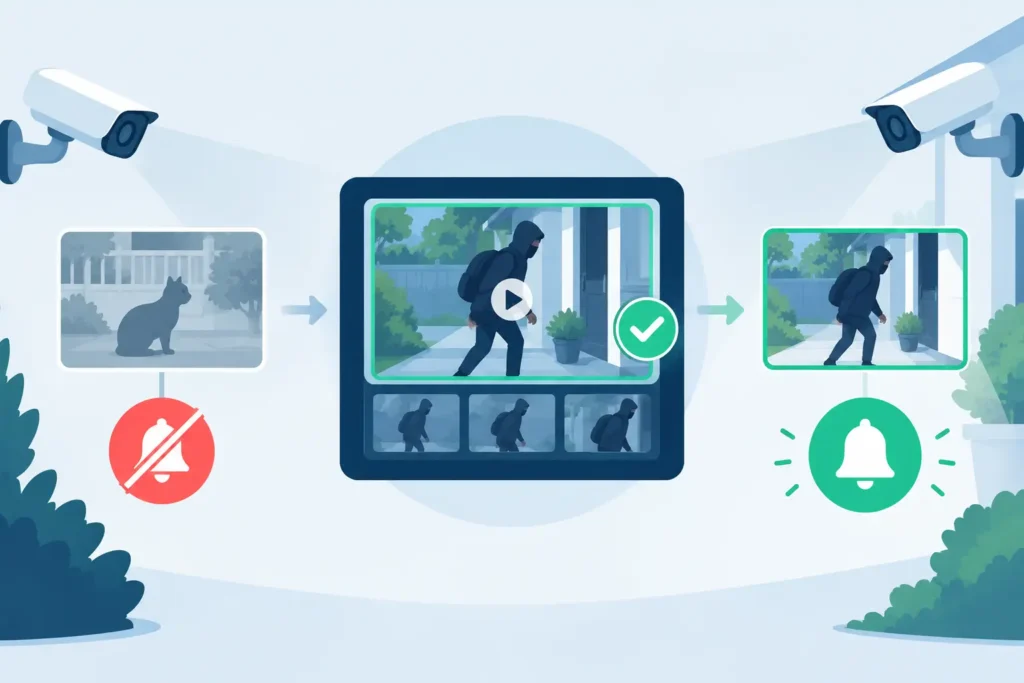
A back door alarm sounds at 2:15 a.m. Is it a break-in, a delivery truck, severe weather, or an employee who entered without disarming the system? That answer determines everything that follows. Video verification reduces false alarms by giving a monitoring team visual context before an event becomes an unnecessary dispatch, disruption, or expense.
For property owners and business operators, fewer false alarms do not mean less security. They mean a more precise response. When cameras, analytics, alarm systems, and trained monitoring professionals work together, security events can be assessed quickly and handled according to the real level of risk.
Why false alarms create a real operational problem
False alarms are more than an inconvenience. Repeated activations can pull staff away from their work, disturb tenants or customers, create costly callouts, and reduce confidence in the security system. In some jurisdictions, frequent false dispatches can also lead to fines or reduced police response priority.
The larger concern is alarm fatigue. When a site experiences frequent alerts caused by motion, weather, wildlife, equipment issues, or user error, people may begin treating every notification as routine. That is exactly when a genuine intrusion can be missed or handled too slowly.
Traditional alarm systems are designed to detect a change: a door opens, a motion sensor activates, glass breaks, or a perimeter beam is crossed. Detection is essential, but detection alone does not explain what caused the event. Video verification adds the missing context.
How video verification reduces false alarms
Video verification pairs an alarm signal with live or recorded camera footage from the affected area. Instead of responding only to a sensor activation, a monitoring professional can review what is happening on site and decide whether the event requires escalation.
For example, a motion alert near a fenced storage yard may be triggered by blowing debris. Video review can confirm that no person entered the property, allowing the event to be documented and closed without dispatching a guard or contacting emergency services. If the footage shows someone climbing the fence or attempting to access a loading door, the response can be immediate and informed.
This process helps separate activity from threat. It gives security teams a clearer picture of who is present, where they are moving, and whether they are attempting to gain access, damage property, or remain on site without authorization.
Verification also improves the quality of an escalation. When a guard, site contact, or police service is needed, responders can receive useful details such as the location of the person, direction of travel, clothing description, vehicle information, or point of entry. That information supports a faster, more focused response.
The technology works best as an integrated system
Video verification is not simply a camera mounted beside an alarm panel. Reliable results depend on the design of the full security program. Cameras must cover the right locations, deliver usable images in changing light, and remain available when an alarm occurs. Alarm zones should be clearly mapped to corresponding camera views so that an operator can assess the event without delay.
AI-enabled video analytics can further improve accuracy by identifying people, vehicles, line-crossing events, loitering, or activity in restricted areas. This allows the system to filter out common non-threat events before they create an unnecessary alert. A camera watching a rear entrance, for instance, can be configured to prioritize a person approaching the door after hours rather than reacting to every passing headlight or moving tree branch.
Analytics are valuable, but they are not a replacement for professional judgment. Lighting conditions, unusual site activity, camera angles, and environmental changes can affect any automated system. Human review remains especially important for high-risk sites, sensitive facilities, and situations where the consequences of a missed event are significant.
Where verification delivers the greatest value
Commercial properties often see immediate benefits because they have multiple access points, after-hours activity, contractors, deliveries, and changing staff schedules. Retail locations can use video verification to distinguish between a legitimate opening procedure and suspicious access. Warehouses and industrial yards can verify perimeter alarms before sending personnel into a potentially unsafe situation.
For residential properties, a verified alert can provide reassurance when homeowners are away, traveling, or managing a second property. A monitoring team can assess activity around doors, garages, driveways, and outdoor areas before contacting the homeowner or arranging a response.
Institutions, offices, and multi-tenant buildings also benefit from a documented response process. When an alert occurs, management needs more than a vague notification. They need to know what happened, what action was taken, and whether follow-up is required. Verified events create clearer incident records for operations, insurance, employee safety, and future security planning.
Faster response does not mean automatic dispatch
A common misconception is that every alarm should result in the same response. That approach can create unnecessary cost and strain resources. The right response depends on the verified threat, the site’s operating hours, the value of assets at risk, the presence of employees or residents, and established escalation procedures.
A verified intrusion at an empty facility may call for an immediate guard dispatch and police notification. An employee entering through an incorrect door may require a call to a site manager. A camera view that confirms no suspicious activity may only need documentation and a maintenance check if the alarm repeats.
This flexibility is why customized security planning matters. The goal is not to minimize alerts at any cost. The goal is to ensure that meaningful alerts receive urgent attention while nuisance events are handled efficiently and consistently.
Four factors that improve verification accuracy
The best video verification program begins with a site assessment. Cameras should be positioned to capture faces, access points, license plates where appropriate, and the paths people are most likely to use. Coverage that is too wide or poorly lit can limit the value of video at the moment it is needed.
Accuracy also depends on four practical factors:
- Clear alarm-to-camera mapping: Each alarm zone should trigger the most relevant camera views, not force an operator to search through a large system.
- Reliable lighting and image quality: Low-light cameras, proper exterior lighting, and clean lenses help ensure footage remains useful overnight and in poor weather.
- Thoughtful analytics settings: Detection rules should reflect the site, including authorized activity, traffic patterns, wildlife, and restricted hours.
- Ongoing testing and maintenance: Camera health, connectivity, alarm devices, and backup power should be checked before a real event exposes a problem.
A system that was correctly installed years ago may still need adjustment. Construction, landscaping, changing inventory layouts, new entrances, and altered business hours can all affect detection accuracy.
Video verification supports safer decisions
For teams responsible for security, the value of verification extends beyond false alarm reduction. It can reduce the need for employees to investigate a dark parking lot or isolated building alone. It can help a remote monitoring operator determine whether to send a guard, notify a keyholder, or escalate to emergency services. It can also preserve video evidence when an incident is confirmed.
There are limits to consider. Camera coverage may be affected by severe weather, blocked views, network outages, or activity outside the field of view. Privacy requirements must also be respected, particularly in workplaces, residential settings, and facilities open to the public. A professional provider should address camera placement, retention practices, access controls, and local requirements during system design.
The strongest approach combines technology with clearly defined human response. Every stakeholder should understand who receives notifications, who can authorize access, when a guard is dispatched, and how incidents are documented. That structure keeps a security program dependable when pressure is high.
At Maritect Investigations & Security Limited, integrated alarm, video, remote monitoring, and guard services can be tailored around the way a property actually operates. The result is not simply more alerts. It is clearer information, more confident decisions, and a security response that stays focused on what truly requires attention.
A false alarm may be unavoidable from time to time. Repeated uncertainty does not have to be. When video gives every alarm a clearer story, property owners can protect people, assets, and daily operations with greater confidence.
