

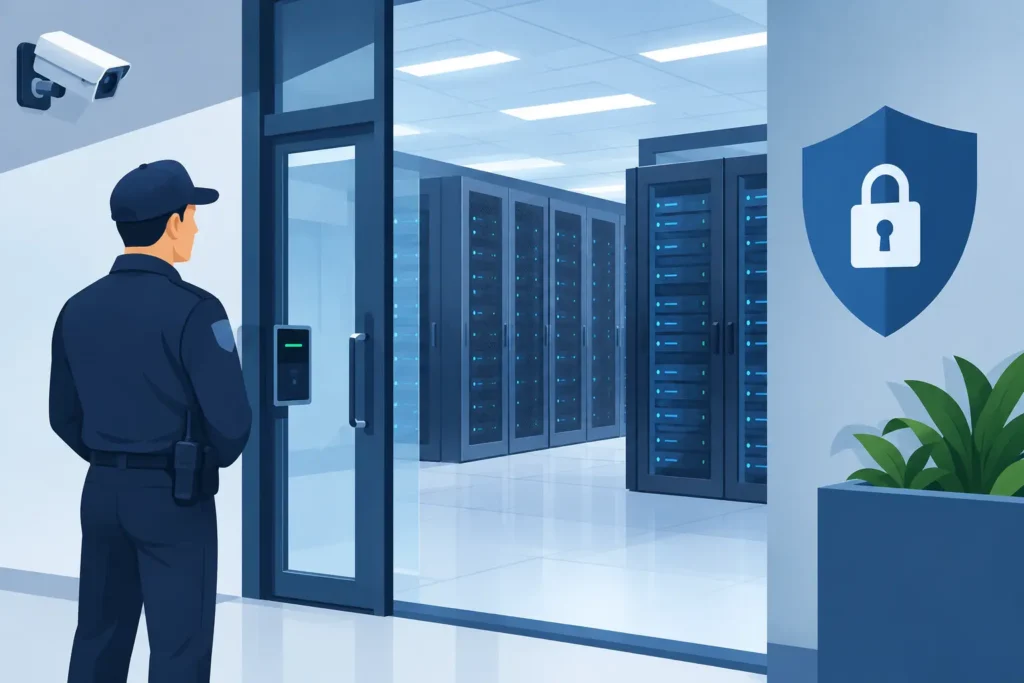
A data center can have redundant power, backup connectivity, and carefully managed cooling, yet a single unauthorized person at the wrong door can still create a serious outage, safety issue, or compliance failure. Data center physical security protects the people, equipment, and operating continuity behind every hosted application, transaction, and service your organization depends on.
The goal is not simply to keep doors locked. Effective protection establishes controlled movement from the property perimeter to the server rack, documents who entered and why, detects unusual activity early, and ensures someone is ready to act when an alarm occurs. The right approach depends on the facility’s size, criticality, staffing model, and customer obligations, but the principle remains the same: physical access must be deliberate, visible, and accountable.
Why Data Center Physical Security Is an Uptime Issue
A physical incident can quickly become an operational incident. Tailgating through a staff entrance, a visitor left unescorted, theft of a network component, or damage to power and cooling infrastructure can disrupt service well beyond the room where it started. Even when equipment is not harmed, an incomplete access record can complicate investigations, insurance claims, and customer reporting.
Facilities managers also face a practical challenge: security cannot slow authorized technicians, vendors, and emergency personnel to the point that routine work becomes difficult. A strong program balances protection with operational flow. It gives approved people the access they need, restricts everyone else, and creates a clear record without relying on memory or informal handoffs.
For colocated environments and organizations handling sensitive information, physical controls are also part of trust. Clients and auditors want evidence that systems, media, and infrastructure are protected around the clock. Written procedures matter, but they must be supported by working technology, trained personnel, and regular testing.
Build Security in Layers, Not at One Door
The most dependable facilities do not depend on a single camera, card reader, or guard station. They use layered controls that increase in strength as a person moves closer to critical equipment.
The first layer begins at the property line. Fencing, gates, exterior lighting, clear site boundaries, and monitored cameras discourage casual trespassing and help identify activity before someone reaches the building. Camera placement should cover vehicle approaches, loading areas, pedestrian entrances, generators, fuel storage, and other vulnerable infrastructure. Poor lighting or blind spots at the perimeter can turn a minor after-hours event into an investigation with few answers.
The next layer is the building entrance. Controlled doors, credential readers, intercoms, visitor verification, and intrusion alarms help ensure that access is granted intentionally. Video should provide a usable view of the person entering, not merely a distant image of a doorway. When an alarm or forced-door event occurs, remote monitoring personnel need enough context to assess the situation and follow the appropriate response procedure.
Inside the building, access should become more restricted. Offices, staging areas, network rooms, electrical rooms, mechanical spaces, and data halls should not all have the same permissions. A technician may need access to a designated cage or rack row without receiving unrestricted access to power distribution, cooling controls, or another customer’s equipment.
At the most sensitive points, facilities may use mantraps, turnstiles, biometric verification, locked cabinets, and individual rack access controls. These measures are not necessary for every site. A small private server room may be well served by strong electronic access, video coverage, and documented visitor controls. A high-availability colocation facility, financial operation, or healthcare environment may require more stringent separation and identity verification.
Control Access With Clear Rules and Useful Records
Access control is most effective when it reflects how the facility actually operates. Credentials should be assigned to a person, not shared among teams. Permissions should be based on job responsibilities, approved work areas, and appropriate schedules. Temporary access for contractors and vendors should expire automatically rather than remaining active after a project ends.
This requires more than issuing badges. Organizations should have a clear process for approving access, changing permissions, recovering credentials, and promptly removing access when employment or contracts end. Scheduled reviews are valuable because permissions tend to accumulate over time, particularly in facilities with rotating contractors or evolving responsibilities.
Visitor management deserves the same discipline. Require sign-in, verify identification where appropriate, issue visible visitor credentials, and record the purpose of each visit. High-risk areas should require an escort unless the visitor has been formally approved for independent access. Delivery personnel, maintenance crews, cleaning staff, and emergency vendors all need procedures that fit their role without creating uncontrolled entry points.
Access records and video footage should work together. If a door is opened at an unusual hour, the facility should be able to determine which credential was used, whether another person entered behind the authorized user, and what occurred nearby. This is where integrated systems offer real operational value: security teams can investigate events quickly instead of sorting through disconnected logs and hours of footage.
Use Video Analytics for Earlier Awareness
CCTV is a central part of data center physical security, but recording footage alone is not the same as active protection. The real advantage comes from meaningful alerts, verified response, and footage that can support an investigation.
AI-powered video analytics can help identify people entering restricted zones, vehicles approaching after hours, loitering near entrances, or movement around critical exterior equipment. Properly configured analytics reduce the burden of watching every camera feed continuously. They direct attention to events that may require action.
Configuration matters. An overly sensitive system can generate alerts for weather, wildlife, shadows, or ordinary traffic, causing alert fatigue. A system that is too loosely configured may miss the activity it was meant to detect. Camera angles, lighting, retention periods, analytic rules, and response instructions should be reviewed after installation and adjusted as site conditions change.
Remote monitoring adds another layer of protection when onsite staff are limited or unavailable. A trained monitoring team can review alarm and video events, follow escalation instructions, contact designated staff, dispatch guards when required, or involve emergency services based on the situation. That response plan should be specific. “Call someone if there is a problem” is not enough for a facility supporting critical operations.
Protect the People Who Keep the Facility Running
Security technology supports people, but it does not replace trained judgment. Onsite guards can provide a visible presence, manage visitor entry, conduct patrols, inspect doors and perimeter conditions, and respond to issues that require a person at the site. Their role is especially valuable during construction, maintenance windows, deliveries, staffing gaps, or periods of elevated risk.
Guard duties should be written for the facility, not copied from a generic post order. Personnel need to know which rooms are restricted, how to handle vendor arrivals, who may authorize emergency access, what to do during a fire alarm, and when to escalate a suspicious event. They also need reliable communications and a way to document incidents clearly.
Security awareness applies to data center staff as well. Employees should understand anti-tailgating expectations, badge reporting procedures, visitor escort rules, and the importance of challenging unfamiliar people in restricted areas through established protocols. A polite question at the right moment can prevent an incident that cameras only document afterward.
Test the Program Before an Incident Tests It
Security systems can appear functional until a real event exposes a gap. Doors may fail to latch, cameras may be blocked by new equipment, access permissions may be outdated, or emergency contact lists may lead nowhere after hours. Regular inspections and testing are how facilities find these weaknesses early.
Test forced-door alarms, panic devices, intercoms, camera views, backup power for security equipment, and notification procedures. Review access logs for unusual patterns, confirm that video retention meets operational needs, and inspect exterior conditions after seasonal changes or construction activity. If your facility relies on a monitoring center or guard response, conduct scenario-based exercises so everyone understands the expected actions and handoffs.
Documentation should be practical and current. Incident reports, maintenance records, visitor logs, and access reviews create an evidence trail while revealing recurring problems. If the same exterior gate alarm occurs repeatedly, or staff frequently prop open one door for convenience, the issue may be design, workflow, training, or maintenance rather than individual behavior.
Choose a Security Partner That Supports the Whole Operation
Data centers often need more than cameras or card readers. They need a coordinated program that includes assessment, system design, installation, monitoring, maintenance, response procedures, and, when needed, trained onsite personnel. Working with one accountable security partner can reduce gaps between technology, human response, and facility operations.
Maritect Investigations & Security Limited helps organizations build customized physical security programs that combine AI-enabled surveillance, access integration, remote monitoring, and protective services. The objective is straightforward: give facility teams timely awareness, reliable documentation, and support when a security event demands action.
The best time to identify a weak perimeter, outdated credential policy, or unmonitored door is during a planned review, not after an interruption. A focused assessment of your site can turn physical security from a background requirement into a dependable part of operational continuity.
