

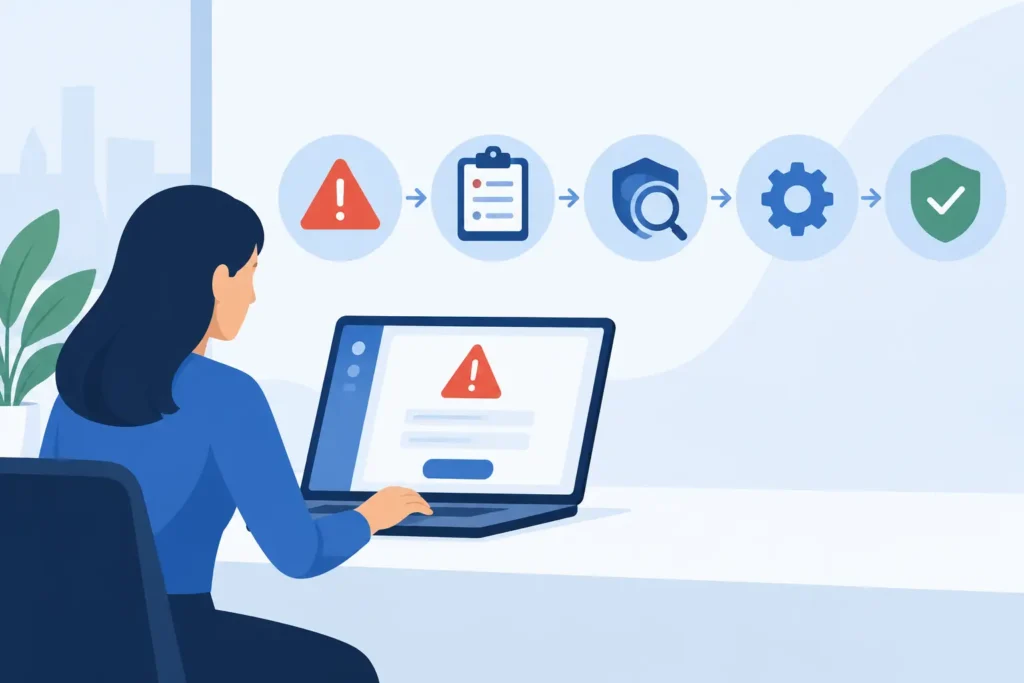
A camera alert, a forced door, a suspicious vehicle, or an employee concern can become a costly problem when the details are unclear. Security incident reporting gives your team a disciplined way to record what happened, protect evidence, assign responsibility, and make a timely decision. For property owners and managers, the report is not paperwork after the fact. It is part of the response.
A strong reporting process connects people, technology, and procedures. It helps a remote monitoring operator communicate with an on-site guard, gives management a reliable account of the event, and creates a record that can support insurance, police involvement, employee action, or future security improvements.
What Security Incident Reporting Should Accomplish
The purpose of a security report is simple: provide an accurate, useful account that allows the right people to act. It should establish what was observed, when and where it occurred, who responded, what actions were taken, and whether the incident remains active.
That sounds straightforward, but weak reports create uncertainty at exactly the wrong time. A note such as “alarm went off, checked building” does not tell a manager whether there was visible damage, whether video was reviewed, whether police were contacted, or whether the site was secured. It also fails to show whether the event was a false alarm, a maintenance issue, or an attempted intrusion.
Good reporting is factual rather than speculative. Staff should describe behavior and conditions they observed, not assumptions about intent. “An individual wearing a dark jacket was seen testing the rear delivery door at 10:14 p.m.” is useful. “A thief tried to break in” may be true, but it is a conclusion that should be supported by evidence.
This distinction matters for businesses, residential properties, schools, warehouses, retail sites, and high-risk facilities alike. Clear language protects the credibility of the report and gives investigators, insurers, and leadership a reliable starting point.
The Information Every Incident Report Needs
Every organization can tailor its forms to its operations, but the essential information remains consistent. Reports should identify the date and time of discovery, exact location, reporting person, involved parties when known, and a chronological account of events.
The chronology is especially valuable. It should show when an alert was received, when the site or camera feed was checked, when a guard or manager arrived, when emergency services were called if necessary, and when the area was returned to normal operation. This creates accountability without forcing staff to write lengthy narratives.
A complete report should also document the condition of the site. That may include damaged doors, broken glass, missing inventory, access-control activity, alarm status, lighting conditions, vehicle descriptions, or the location of relevant camera coverage. If there is video footage, note the camera number or area, the time range, and whether the footage was preserved.
Photos and video can strengthen a report, but they do not replace written observations. A camera may show movement near an entrance, while the responding officer or guard can document that the strike plate was loose, the alarm panel displayed a fault, and no unauthorized entry was confirmed. Together, those details provide a more complete picture.
Reports Must Match the Type of Incident
A one-size-fits-all report can leave out the details that matter most. The core format can stay consistent, but staff should be trained to capture incident-specific facts.
For a theft or vandalism event, document the point of entry, damage, affected property, inventory counts if available, and evidence preservation steps. For trespassing, record the person’s description, direction of travel, warnings given, and whether they left voluntarily. For workplace conflict, reports should focus on observable conduct, exact statements when possible, witnesses, separation measures, and any immediate safety concerns.
Medical emergencies require added discretion. Record the time assistance was requested, the actions taken, the arrival of emergency responders, and the operational impact on the site. Avoid including unnecessary personal or medical details in broadly circulated reports. Privacy and need-to-know access should shape how those records are handled.
Labor disputes, protests, and strike-related activity require calm, detailed documentation. Record crowd size estimates, access points affected, traffic disruptions, interactions with employees or visitors, property concerns, and de-escalation actions. The goal is not to characterize lawful activity as a threat. It is to identify actual risks to people, property, and business continuity.
Make Reporting Part of the Response Plan
The best report starts before an incident occurs. If employees and security personnel are unsure who receives reports, where they are stored, or who can approve follow-up action, delays are likely. A practical reporting plan defines the chain of notification for different event types and sets expectations for response times.
For example, an access-control alert after business hours may require remote verification, live camera review, and dispatch of a mobile or on-site responder. A confirmed forced entry may require police notification, perimeter protection, evidence preservation, and immediate communication with a designated client contact. The report should reflect each step, including any decision not to escalate and the reason for it.
Integrated systems make this process more reliable. AI-enabled video analytics can identify people, vehicles, perimeter activity, or unusual movement and send an alert for review. Alarm systems can identify the zone that triggered. Access-control records can show whether a door was opened with valid credentials. A trained person still needs to evaluate the information, but technology reduces the time spent searching for the facts.
That is where 24/7 monitoring can make a meaningful difference. An event discovered at 2:00 a.m. is easier to manage when trained operators can assess available video, follow established instructions, notify the appropriate contact, and document actions as they occur. The result is faster awareness and a cleaner record by morning.
Protect Evidence Without Creating New Risk
When an incident may involve a crime, staff should prioritize safety and avoid disturbing the scene. Do not touch discarded items, clean up damage, or allow unnecessary traffic through the affected area before law enforcement or authorized investigators have assessed it. If immediate action is needed to prevent further damage, document what was moved or secured and why.
Video retention deserves the same attention. Many systems overwrite footage after a defined period. Once an incident is identified, the relevant time window should be saved promptly, with enough footage before and after the event to provide context. Record who exported or accessed the footage, when it was secured, and where it is retained.
Not every incident requires police involvement, and not every report needs the same level of detail. A recurring door-prop violation may be handled through internal coaching and access-control adjustments. A threat, assault, break-in, or significant loss calls for a more formal escalation. The key is to make those decisions under a written policy rather than in the pressure of the moment.
Turn Reports Into Better Security Decisions
Incident reports are most valuable when they are reviewed for patterns. One after-hours alarm may be a sensor issue. Several alerts at the same entrance, at similar times, may point to a lighting gap, a failing door, repeated trespassing, or a process problem with closing staff.
Facilities managers should periodically look for repeat locations, times, causes, and response delays. Ask whether cameras cover the right approach routes, whether alarm zones are properly configured, whether employees understand access procedures, and whether guards have the information they need when they arrive. Reports should guide preventive action, not sit in a folder until a claim or complaint arises.
Maritect Investigations & Security Limited helps clients build integrated protection programs that connect surveillance, alarms, access systems, monitoring, and human response. When those services operate from a clear incident process, every alert can be assessed with greater speed, consistency, and control.
A useful report does more than describe a difficult moment. It gives your team the facts to secure the site, communicate with confidence, and reduce the chance that the same vulnerability will be exposed again.
