

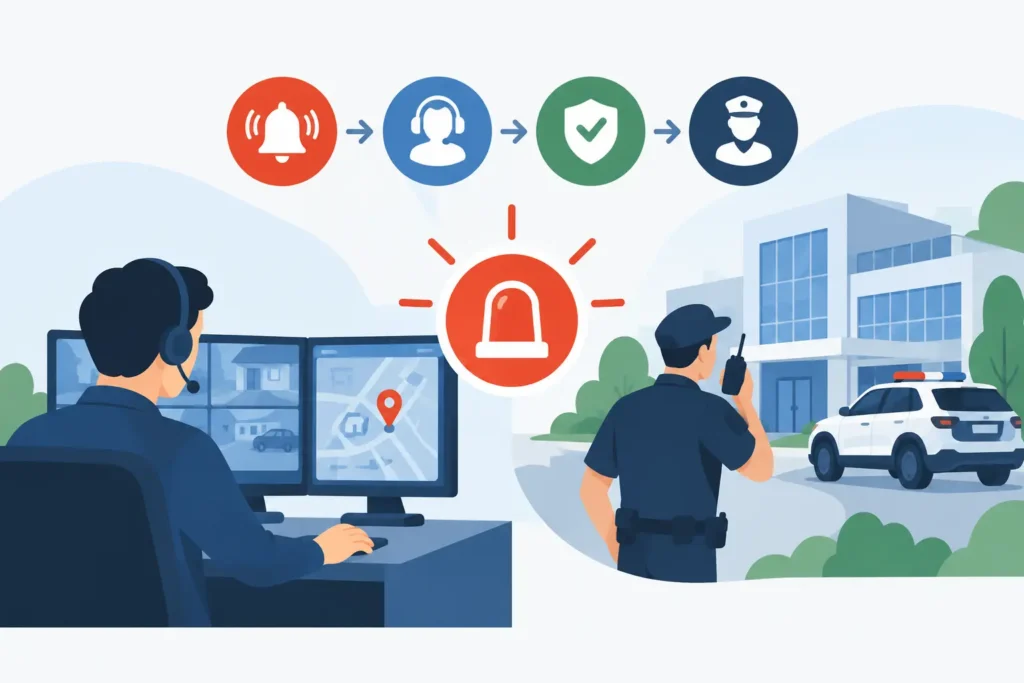
A burglar alarm sounds at 2:13 a.m. at a closed facility. The most costly mistake is not always a system failure – it is uncertainty about who acts next. A clear alarm response protocol turns an alert into an organized decision: verify the event, protect people, contact the right responders, and document what happened.
For property owners, facilities managers, and business operators, this is more than a checklist stored in a binder. It is an operational plan that determines whether an after-hours alarm leads to a fast, controlled response or a delayed call chain with no one accountable.
What an Alarm Response Protocol Should Accomplish
An alarm response protocol defines the actions taken from the moment a signal is received through incident resolution and follow-up. It should account for the type of alarm, the time of day, who is on site, the level of risk, and the resources available.
The goal is not to treat every alert as an emergency. False alarms, user error, equipment faults, and environmental conditions happen. The goal is to assess each signal quickly without assuming it is harmless. A verified intrusion, panic alarm, fire signal, or critical equipment alert may require very different actions.
A practical protocol should answer several questions before an incident occurs. Who receives the first notification? Can video or access-control data help verify the event? Who has authority to contact police, fire services, management, or a security officer? Who can safely attend the site? How will the event be recorded and reviewed?
When those decisions are made in advance, employees are not forced to improvise under pressure.
Start With Life Safety, Not Property
Every response plan must put people first. If an alarm indicates a possible immediate threat to employees, residents, visitors, or the public, the protocol should direct personnel to move to safety and contact emergency services. Staff should never be expected to investigate a potentially dangerous intrusion, confrontation, or suspicious person on their own.
This matters especially for businesses with lone workers, late shifts, public-facing staff, or isolated sites. A panic button at a reception desk, for example, needs a different response path than a motion detector in an empty stockroom. The first may call for immediate emergency escalation. The second may begin with remote video verification and dispatch of a trained responder.
Your plan should also recognize that a person arriving at a site may be walking into an unknown situation. A keyholder can be valuable for access and decision-making, but they are not automatically the right person to perform a physical check. In many cases, a trained security officer provides a safer, more accountable response.
Build a Clear Alarm Response Protocol by Event Type
One generic response procedure creates gaps. Instead, organize the protocol around the signals your site can produce and assign a response level to each one.
Intrusion and perimeter alarms
An intrusion alarm may be triggered by a door contact, glass-break sensor, motion detector, gate, or fence-line device. The first step is to determine whether the system is armed correctly and whether recent access activity explains the signal. If integrated video is available, a monitoring professional can review relevant camera views for visible movement, forced entry, or suspicious vehicles.
If a threat appears credible, the protocol should identify who contacts law enforcement and who dispatches onsite security. If the event cannot be verified, the response may still require a site check, particularly at high-value, isolated, or repeatedly targeted locations. The appropriate choice depends on the property, the alarm history, and the potential loss exposure.
Panic and duress alarms
Panic alarms demand urgency. Do not build a verification process that delays help when an employee may be in danger. The protocol should specify the emergency contact sequence, the exact site address and entry details, and how to notify designated management without compromising the safety of the person who activated the alarm.
Employees should know that a panic alarm is not a substitute for calling 911 when they can safely do so. Training should also cover accidental activations, including how to report them quickly through the approved contact channel.
Fire, environmental, and critical-system alerts
Fire alarms must follow applicable fire-code requirements and the instructions of the authority having jurisdiction. A security monitoring plan can support notification and documentation, but it cannot replace required fire alarm procedures.
Environmental alerts – such as low temperature, water leak, power failure, or equipment-room overheating – often have a slower escalation path but can still cause serious operational loss. A server room temperature alert, for example, may require notification of facilities and IT personnel before equipment is damaged. Define the acceptable response window and the person authorized to approve emergency repairs.
Define Roles Before the Phone Rings
A reliable response depends on defined responsibilities, not a long list of names. Contact lists change, employees leave, and decision-makers may be unavailable. Each role should have a primary and backup contact, current phone numbers, and clear authority limits.
Your monitoring center or alarm provider should know who is authorized to cancel an alarm, request a guard dispatch, approve access for contractors, or authorize police notification when the situation is not already governed by emergency procedures. Provide current opening and closing schedules, holiday hours, and instructions for locations with multiple tenants or separate access zones.
For a commercial site, the response team commonly includes a monitoring operator, an onsite or mobile security officer, a keyholder, a facilities contact, and senior management. The protocol should state the order in which they are contacted and when escalation moves to the next person. Avoid relying on a single owner or manager who may be traveling, asleep, or unavailable.
Use Verification to Improve Decisions
Video verification and access-control activity can add context that an alarm panel alone cannot provide. A camera view may show whether a delivery truck triggered a perimeter device, whether an employee entered with valid credentials, or whether a door has been forced open.
That context helps reduce unnecessary dispatches while strengthening the response to genuine threats. Still, video has limits. Poor lighting, camera blind spots, weather, network interruption, or a concealed intruder can prevent confirmation. A lack of visible activity should not automatically close an event when other signs indicate risk.
The strongest approach combines technology with trained human judgment. AI-enabled video analytics can flag people, vehicles, line crossing, or unusual activity, while a monitoring professional evaluates the alert against the site plan and response instructions. This provides faster awareness without assuming automation can make every security decision.
Make Onsite Response Safe and Accountable
When an officer, manager, or contractor attends a site, the protocol should establish how they check in, what areas they may access, and what they must do if they find signs of entry or damage. They should not disturb a potential crime scene, confront suspects, or enter an area where there may be an active threat.
A trained response should focus on observation, safe positioning, communication, and preservation of useful information. Relevant details may include open doors, broken windows, vehicle descriptions, direction of travel, camera locations, and the time each action occurred.
After the situation is stable, the responder should secure the property where possible, rearm the system only when appropriate, and report any condition that could cause another alarm. If a damaged door cannot be secured, the protocol should identify whether to arrange emergency repairs, maintain a guard presence, or use temporary security measures.
Document Every Alarm, Including the False Ones
Alarm records reveal patterns that individual incidents can hide. A recurring false alarm near the same loading door may indicate a failing sensor, poor closing procedure, an access-control issue, or a training gap. Repeated after-hours activity in one camera zone may justify changes to lighting, patrol routes, or analytics settings.
Each incident report should capture:
- Date, time, location, and alarm type
- Parties notified and the time of each contact
- Verification steps, including relevant camera or access activity
- Actions taken by monitoring staff, responders, and emergency services
- Findings, damage, follow-up needs, and final system status
Review these records regularly, not only after a serious event. Monthly reviews can identify nuisance alarms and maintenance needs. After a significant incident, conduct a prompt debrief while details are fresh. Ask whether the alert reached the right people, whether instructions were current, whether response times were acceptable, and whether the site was properly secured afterward.
Test the Plan Under Real Conditions
A protocol that looks complete on paper may fail during a weekend outage or staff turnover. Test notification lists, alarm communication paths, access instructions, and escalation decisions on a defined schedule. Include after-hours scenarios, because that is when many sites have the fewest available resources.
Training should be practical. Staff need to know how to activate and disarm systems, report an accidental activation, use duress devices, and follow evacuation or shelter procedures. Managers need to understand when they should stay away from the site and allow police, fire personnel, or trained security professionals to take control.
Maritect Investigations & Security Limited can help organizations align monitored alarms, video analytics, access control, mobile response, and onsite protection around one coordinated operating plan. The right protocol is customized to the property, its people, and the risks that matter most.
An alarm is only the first signal. Give your team clear instructions, current contacts, and a response partner ready to act, so the next alert is handled with confidence rather than confusion.
