

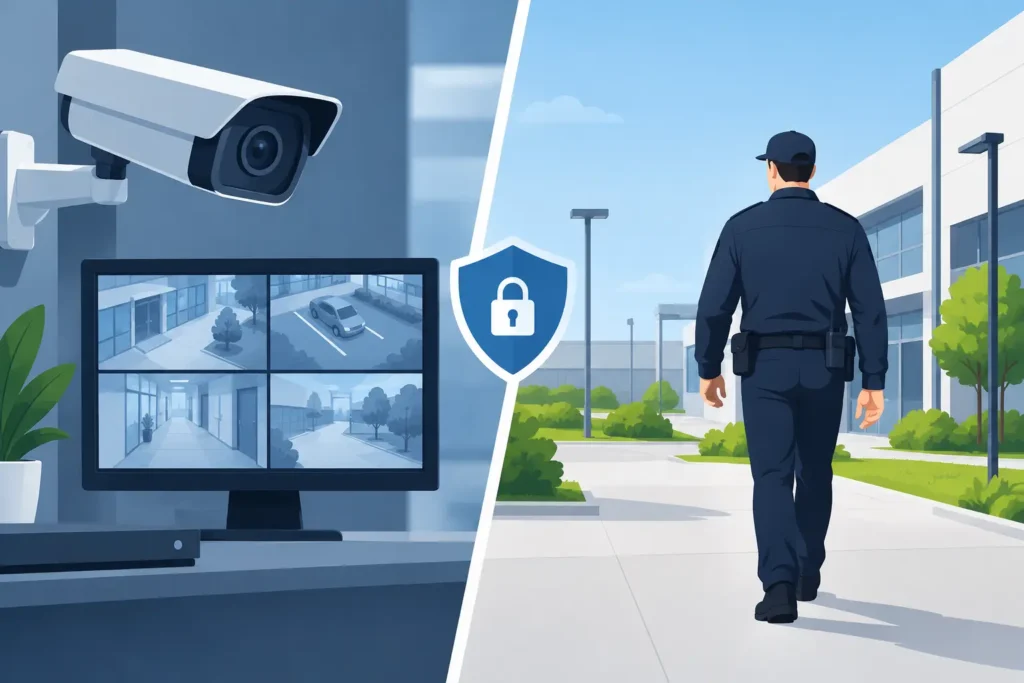
A loading dock door is found open at 2:00 a.m. A camera can show when it happened, who entered, and where they went. A patrol officer can secure the door, check the building, and respond to a person still on site. That is the practical question behind CCTV versus security patrols: not which option sounds stronger, but which one addresses the risk your property faces when it matters.
For many businesses, residential properties, and institutions, the answer is not an either-or decision. Cameras and patrols solve different parts of the security problem. The right choice depends on the size of the site, the value of the assets, operating hours, incident history, and how quickly someone must act when an alert occurs.
What CCTV and Security Patrols Actually Do
CCTV provides continuous visibility. Modern systems can record high-definition video across entrances, parking areas, corridors, loading zones, perimeter points, and other vulnerable locations. AI-powered analytics can identify people, vehicles, line crossing, loitering, or activity in a restricted area, helping reduce the time spent reviewing routine footage.
Its strengths are consistency and documentation. A properly designed camera system does not take breaks, forget details, or rely on a single person’s memory. It can provide a clear record for internal reviews, insurance claims, police reports, employee investigations, and ongoing loss-prevention efforts. When paired with 24/7 remote monitoring, an alert can be assessed in real time rather than waiting for someone to discover an incident the next morning.
Security patrols provide a human presence. Uniformed officers can inspect doors and gates, identify unsafe conditions, challenge unauthorized visitors, escort employees, manage access, and make judgment calls that a camera cannot make on its own. Visible patrol activity may also discourage opportunistic theft, vandalism, trespassing, and unauthorized after-hours use of a property.
Patrols are particularly valuable where a response must be physical and immediate. An officer can investigate an alarm activation, meet emergency responders, secure an area after damage, or remain on site during a sensitive event. The limitation is coverage: one officer cannot watch every door, hallway, and exterior area at the same moment.
CCTV Versus Security Patrols: The Main Differences
The clearest distinction is between observation and intervention. CCTV observes, records, and alerts. Security patrols inspect, assess, and intervene. Both can deter incidents, but they do so differently.
Coverage and consistency
Cameras can maintain coverage across many locations at once. A multi-building property, retail store with several entrances, or industrial site with a large perimeter can be monitored without placing an officer at every point. Camera coverage is especially effective for recurring areas of concern, such as receiving doors, parking lots, cash-handling areas, storage rooms, and access gates.
Patrol coverage moves. This is useful when officers need to inspect a changing environment, but it also means there are intervals between checks. Randomized patrol patterns can make those intervals less predictable, yet they do not provide the constant visual record of a camera system.
Response capability
A camera alone cannot lock a damaged door, escort a staff member to their vehicle, or separate a disruptive visitor from a workplace. If an incident requires direct action, a trained officer or emergency service response is necessary.
That does not make CCTV passive. Remote monitoring can verify whether an alert is a real threat, issue live audio warnings when appropriate, notify key contacts, and dispatch a patrol or emergency responders based on established procedures. Verified alerts can help clients avoid unnecessary callouts while focusing attention on genuine incidents.
Evidence and accountability
Security patrol reports document officer activity, observations, and incidents. These reports can be valuable for compliance, management oversight, and demonstrating that scheduled checks occurred. Cameras add visual evidence that can confirm timelines and provide a fuller account of what happened.
For sites with repeated losses, employee misconduct concerns, or disputed incidents, recorded video often becomes essential. The quality of that evidence depends on good system design. A camera pointed generally at a door may not capture a usable face, license plate, or event sequence. Placement, lighting, retention periods, and maintenance all matter.
Cost and scalability
CCTV usually requires an upfront investment in cameras, recording equipment, network infrastructure, installation, and configuration. Ongoing costs may include monitoring, maintenance, software, storage, and connectivity. Once installed, however, cameras can expand coverage across a property without the cost of assigning a full-time officer to every area.
Security patrols create an ongoing service expense, but they can be deployed flexibly. A business may need mobile patrol checks after closing, overnight coverage during a construction phase, or temporary officers during a labor dispute, event, or elevated threat period. The right level of guarding can change as operations change.
When CCTV Is the Better Starting Point
CCTV is often the strongest first layer of protection when a property needs broad, continuous visibility. It is well suited to businesses that want to monitor multiple access points, review incidents, deter theft, and receive faster awareness of after-hours activity.
It can be particularly effective for retail locations, offices, apartment buildings, warehouses, schools, medical facilities, and sites with large exterior areas. A well-planned system can also support operational needs beyond security, such as reviewing deliveries, confirming contractor access, and investigating safety incidents.
Cameras are not a substitute for thoughtful security procedures. They need reliable power, secure network configuration, appropriate retention settings, routine testing, and maintenance. They should also be installed with privacy expectations and applicable laws in mind, particularly in workplaces and shared residential spaces.
When Security Patrols Are the Better Starting Point
Patrols may be the better first investment when visible presence and human judgment are the priority. This includes properties with frequent trespassing, active construction sites, vacant buildings, high-value equipment, recurring alarm activations, or employees working alone after hours.
They are also valuable during temporary periods of elevated risk. A facility dealing with a labor dispute, a retail site facing a pattern of aggressive behavior, or an executive requiring personal protection needs more than recorded footage. These situations require trained professionals who can follow procedures, communicate clearly, and respond proportionally.
Patrol services work best with clear post orders. Officers should know which doors and areas to inspect, what conditions to report, who to contact, when to escalate, and how to document their activity. Without those directions, even a capable officer may be left reacting rather than protecting proactively.
The Strongest Option Is Often an Integrated Program
For many properties, the most dependable answer to CCTV versus security patrols is a coordinated combination. Cameras extend visibility. Monitoring turns that visibility into faster awareness. Patrol officers provide the on-site response that technology cannot deliver by itself.
Consider a commercial property after closing. Video analytics detect a person entering a restricted loading area. A monitoring professional reviews the alert and confirms the activity is suspicious. The response plan can then trigger an audio warning, notify the property contact, send a mobile patrol, or contact police if the circumstances require it. Meanwhile, the footage creates a time-stamped record of the event and the response.
This layered approach also helps security teams use guarding resources more efficiently. Instead of assigning officers to watch fixed locations continuously, cameras can cover routine observation while patrols focus on inspections, response, access control, and situations requiring a visible presence. The result is more control over both coverage and cost.
Integrated systems should include more than cameras and officers where the risk calls for it. Access control, intrusion alarms, smart locks, intercoms, remote monitoring, and documented response procedures can all work together. The objective is simple: detect concerns early, verify what is happening, and send the right response without delay.
Build Around Your Actual Risks
Before selecting cameras, patrols, or both, start with the conditions that create exposure at your property. Review when incidents occur, which areas are hardest to supervise, whether staff are present overnight, how quickly a verified threat needs a response, and what evidence would be needed afterward.
A small office with occasional after-hours access concerns may need monitored cameras and controlled entry. A warehouse with valuable inventory may need perimeter cameras, intrusion detection, and mobile patrol response. A high-profile event or sensitive workplace situation may require uniformed officers on site. There is no useful one-size-fits-all answer.
The most effective security program gives you visibility when no one is present and capable support when a situation needs action. Choose the protection that matches how your property operates, then test it regularly so it performs when your team needs it most.
