

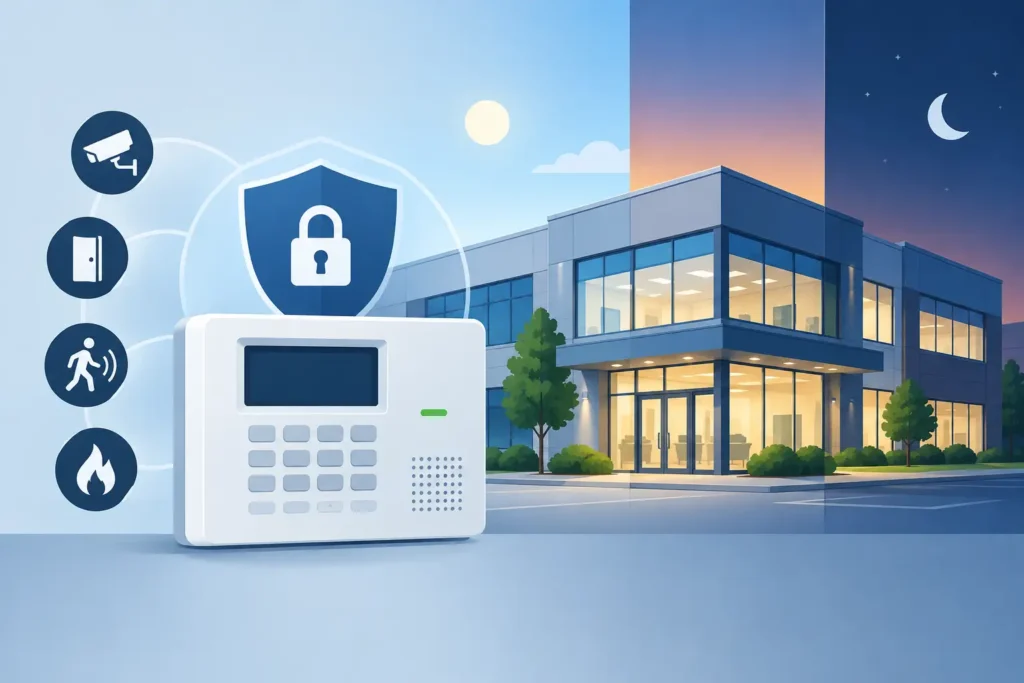
A break-in at 2:00 a.m., a forced door after closing, or an unauthorized person entering a restricted area can become a costly problem before the first employee arrives. Commercial alarm panels give businesses a central point of control for detecting these events, sending alerts, and initiating a response when the property is unattended.
For offices, retail locations, warehouses, medical facilities, multi-tenant buildings, and industrial sites, the panel is more than a keypad on the wall. It is the operating center of the alarm system. When it is selected, programmed, and monitored properly, it helps protect people, assets, access points, and business continuity around the clock.
What Commercial Alarm Panels Do
A commercial alarm panel receives signals from security devices throughout a property. These may include door contacts, motion detectors, glass-break sensors, panic buttons, smoke or heat detection, water sensors, and tamper switches. The panel evaluates those signals based on the system’s programming and determines whether to send an alert, activate a siren, notify a monitoring center, or perform several actions at once.
That coordination matters. A rear-door contact that opens during scheduled deliveries should not receive the same response as a rear door forced open after hours. Commercial systems can be programmed around operating schedules, authorized users, protected zones, and escalation procedures. The goal is not simply to make noise. It is to identify a genuine concern quickly and direct the right response.
Many modern panels also support remote management through a secure app or web portal. Authorized managers can arm or disarm selected areas, review event history, receive notifications, and confirm whether a site has been secured. The right level of access depends on the organization. A single storefront may need simple owner access, while a larger facility may require different permissions for managers, maintenance staff, and security personnel.
Choosing Commercial Alarm Panels for Your Site
The best alarm panel is not always the one with the longest feature list. It is the one that supports the actual risks, operating hours, and response requirements of the facility. A security assessment should begin with how the site functions, not with a box of equipment.
Start with the property layout. Identify every entry and exit point, including staff doors, overhead doors, loading bays, roof access, mechanical rooms, and areas that connect to neighboring units. Consider where valuable inventory, sensitive records, equipment, keys, and controlled materials are kept. Then look at where people may be alone, such as reception areas, cash offices, storage rooms, or late-night workspaces.
A panel also needs enough capacity for the system to grow. Businesses change. A retail operation may add a stockroom, an office may take over another suite, or a warehouse may add access-controlled gates and exterior surveillance. Installing a panel with room for additional zones and devices can avoid an unnecessary replacement later.
Communication is another critical decision. Alarm panels can use cellular, internet, and traditional phone-based paths, depending on the system and site. A single communication path may be sufficient for lower-risk applications, but a business with significant assets or after-hours exposure often benefits from dual-path communication. If an internet connection is interrupted or deliberately cut, cellular backup can help keep alarm signals moving.
There is a trade-off. More connectivity, zones, and integrations can improve visibility and control, but they also require careful setup and ongoing management. Complex security should still be practical for the people expected to use it every day.
Wired, Wireless, or Hybrid Systems
Wired alarm devices are often well suited to new construction, major renovations, and facilities where cabling can be installed without disruption. They offer reliable communication between devices and can be a strong long-term option for large sites.
Wireless devices can be useful where running new cable would be difficult, expensive, or disruptive to operations. They are common in occupied offices, heritage buildings, leased spaces, and sites that need to expand coverage quickly. Battery health and signal quality must be monitored, but professionally designed wireless systems can provide dependable protection.
A hybrid system combines both approaches. This is often the right answer when a business is upgrading an existing system or adding protection to a building with a mix of accessible and hard-to-reach areas.
Integration Turns Alerts Into Action
An alarm panel is most effective when it works with the rest of the security program. Integration with access control can help verify whether a door was opened by an authorized credential or forced open. Integration with video surveillance can give operators visual context when an alarm occurs, helping them distinguish a delivery issue from a genuine intrusion.
For example, an alarm from a loading-door sensor can trigger nearby cameras to display an immediate live view. If video analytics also detects a person entering an area after hours, the monitoring team has stronger information to assess the event and follow the site’s response plan. This can reduce unnecessary dispatches while helping legitimate threats receive prompt attention.
Panic and duress devices are another important application. In customer-facing businesses, healthcare settings, financial offices, or reception areas, a discreet button can provide staff with a direct way to request help. These systems must be programmed with clear escalation instructions. Employees should know when to use them, and designated contacts should understand what happens when an alert is activated.
Fire and life-safety devices may also be connected in some environments, but intrusion, fire, and life-safety requirements are not interchangeable. Code compliance, permitting, inspection requirements, and local authority standards should guide the design. A qualified provider can help ensure each system is installed for its intended purpose.
Monitoring and Response Matter After the Alarm
An alarm panel can detect an event, but detection alone does not protect a vacant property. The response plan determines what happens next.
With 24/7 professional monitoring, alarm signals can be reviewed and escalated according to agreed instructions. Depending on the event and the site’s procedures, this may include contacting keyholders, requesting emergency services, notifying a guard, or documenting the incident for management. For businesses with repeat trespassing, higher-value inventory, or remote locations, monitored alarm coverage can provide meaningful support outside business hours.
Verification is especially valuable where false alarms are a concern. Video verification, properly configured zones, and accurate schedules help monitoring personnel make better decisions. This protects the business from alarm fatigue and can reduce avoidable disruption for employees, law enforcement, and neighboring tenants.
A response plan should answer practical questions before an incident occurs. Who receives a call first? Who can attend the site? What should happen if no keyholder is available? Are there areas a guard should inspect immediately? Are there hazards, restricted zones, or critical operations that responders need to know about?
Installation Is Only the Beginning
Even a high-quality panel will underperform if sensors are poorly placed, users are not trained, or maintenance is ignored. Motion detectors need appropriate coverage and settings. Door contacts must align correctly. Keypads and panic devices need to be accessible without being exposed to unnecessary risk. Every device should be tested after installation and at regular intervals afterward.
User management deserves the same attention. Remove access for former employees promptly, assign unique codes rather than sharing one code across the team, and review who receives alarm notifications. Event logs are more useful when they show exactly who armed or disarmed the system and when.
Routine testing helps identify low batteries, communication failures, damaged devices, and changes to the building that may affect coverage. A renovation, new shelving, a partition wall, or a relocated door can create blind spots that did not exist when the system was first installed.
Maritect Investigations & Security Limited approaches alarm design as part of a wider protection plan, bringing together alarm monitoring, video surveillance, access control, remote support, and on-site response options when the situation calls for them. That integrated approach helps businesses avoid disconnected systems and unclear responsibilities during an incident.
The right commercial alarm panel should fit the way your business actually operates: active when it needs to be, simple for authorized staff to use, and ready to call attention to what should never be ignored. A professional assessment can turn that requirement into a clear plan for protecting every shift, every entry point, and every after-hours hour.
