

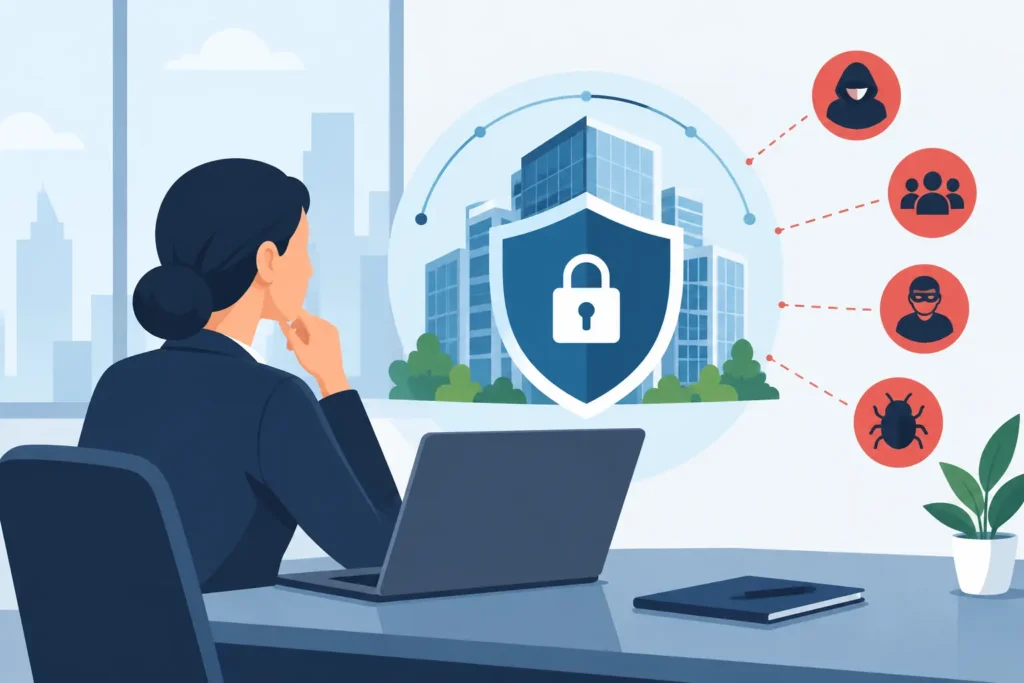
A loading door left unsecured after closing, an access card that was never deactivated, or a camera that records but does not alert anyone can become the opening for a serious incident. A corporate threat assessment brings those exposures into view before they disrupt your people, property, or operations. It replaces assumptions with a clear, site-specific picture of where risk exists, how likely it is to occur, and what response will make a meaningful difference.
For business owners, facilities managers, and security leaders, the goal is not to create more procedures for their own sake. The goal is to protect daily operations with practical controls that staff can follow and security teams can support around the clock.
What a Corporate Threat Assessment Examines
A corporate threat assessment is a structured review of threats affecting an organization, its locations, personnel, assets, and continuity. It looks beyond whether a building has cameras or alarms. It asks whether every layer of security works together when something actually happens.
The assessment begins with the business itself. A retail site managing cash and customer traffic faces different risks than an industrial facility with valuable equipment, a professional office with confidential records, or a residential property with multiple entry points. Hours of operation, surrounding activity, staffing levels, previous incidents, public visibility, and the value of on-site assets all influence the security plan.
Physical vulnerabilities are a central part of the review. These can include poorly lit parking areas, uncontrolled visitor access, blind spots in surveillance coverage, unsecured keys, weak perimeter fencing, unreliable alarm equipment, or doors that do not consistently latch. A site may appear secure during business hours but become exposed during shift changes, weekends, holidays, or after-hours service calls.
People and processes matter just as much. Many incidents begin with a breakdown in routine: a contractor is not verified, a former employee retains access, a delivery is accepted without confirmation, or suspicious behavior is noticed but never reported. A good assessment reviews how staff, visitors, vendors, guards, and management interact with the security program.
Why Security Equipment Alone Is Not Enough
Security technology is highly effective when it is correctly designed, monitored, and supported by clear procedures. It is less effective when it is treated as a one-time installation. A camera pointed at the wrong area, an alarm that sends alerts to an unattended phone, or a badge system with outdated user permissions can provide a false sense of protection.
This is where an assessment creates value. It connects technology to a response plan. For example, AI-enabled video analytics can identify a person entering a restricted area, loitering near a perimeter, or moving through a site after hours. Yet the operational question remains: who receives that alert, how quickly can they verify it, and what happens next?
For some properties, 24/7 remote monitoring is the right answer because it provides immediate review and escalation when a verified event occurs. Other locations may need a combination of monitored intrusion alarms, improved access control, scheduled guard patrols, and better lighting. The right solution depends on the site, the risk level, and the consequences of delay.
The Main Risks to Prioritize
A threat assessment should not treat every concern as equally urgent. Security budgets and staff capacity are finite, so the assessment should rank threats by likelihood, potential impact, and the organization’s ability to respond.
Common priorities include theft of inventory or equipment, trespassing, unauthorized access, workplace violence, vandalism, fraud, data or document exposure, and threats to executives or high-profile personnel. Organizations may also need to prepare for labor disputes, demonstrations, terminations, or events that bring unusual attention to a site.
The highest-priority risks are usually the ones that combine opportunity with limited oversight. An isolated rear entrance, a poorly supervised receiving area, or an unmonitored property after hours may present more immediate exposure than a highly visible main entrance. Incident history can help identify patterns, but it should not be the only factor. A site does not need to experience a major loss before a weakness deserves attention.
Consider Operational Impact, Not Just Loss
The cost of an incident is not limited to stolen property or repair bills. A break-in can delay production, interrupt customer service, affect employee confidence, trigger insurance claims, and consume management time. A security incident involving an employee, visitor, or executive can also create reputational and legal consequences.
Assessments should therefore consider continuity. Can the organization maintain operations if a key entrance is damaged? Is there a clear escalation path if a threat occurs overnight? Can staff access the building safely during an alarm event? These questions move the assessment from a checklist exercise to a continuity tool.
How the Assessment Process Works
An effective process starts with a conversation about what the organization needs to protect and where it has concerns. Leadership may be worried about recurring theft, while facility staff may be concerned about access control gaps or unreliable legacy cameras. Both perspectives are valuable.
The next step is a site review. Security professionals inspect exterior approaches, parking areas, entrances, exits, windows, loading zones, fences, lighting, existing camera views, alarm devices, and critical interior spaces. They also examine how people move through the property during normal hours and at vulnerable times.
Documentation is essential. The assessment should identify each issue, explain the associated risk, and recommend a practical control. Recommendations should be prioritized so decision-makers can address urgent concerns first rather than trying to replace every system at once.
A useful action plan often combines immediate improvements with longer-term upgrades. Immediate measures may include changing access credentials, repairing a damaged door, adjusting camera angles, removing obstructions, or improving reporting procedures. Longer-term work may involve integrating access control, upgrading surveillance coverage, installing monitored alarms, or adding professional guarding for specific shifts or events.
Building Layers of Protection
The strongest security programs use layers. If one control fails or is bypassed, another can detect, delay, or respond to the threat. That does not mean every business needs every security service. It means the program should match the risk.
A commercial office, for instance, may benefit most from visitor management, credentialed access, monitored alarms, and high-definition cameras at entry points. A construction or industrial site may require perimeter detection, mobile patrols, equipment protection, and coverage for remote areas. A retail operation may prioritize theft deterrence, cash-handling procedures, visible surveillance, and rapid response to after-hours alarm events.
The most effective layers work together. Access control can show who entered a space. Video can verify what happened. Alarm monitoring can prompt a response when the property is closed. Onsite guards can provide a visible presence, conduct patrols, manage visitors, and respond to conditions that technology cannot resolve alone.
Maritect Investigations & Security Limited designs these programs around the realities of each property, combining protective services, integrated technology, monitoring, and ongoing support rather than offering a one-size-fits-all package.
Turning Findings Into an Ongoing Program
A corporate threat assessment should not sit in a folder after the initial review. Businesses change. Employees join and leave, hours expand, tenants move, construction changes sightlines, and new equipment introduces new access points. Security controls need the same attention as other operating systems.
Set a schedule to review access permissions, test alarms, inspect cameras, confirm emergency contacts, and revisit incident reports. If your organization experiences a theft, threat, access issue, or near miss, use it to test whether the current response worked as intended. The right question is not simply who was at fault. It is where the process, technology, or coverage could be improved.
Training also deserves regular attention. Staff should know how to report suspicious activity, secure sensitive areas, handle visitors, and respond to alarms or confrontational behavior without putting themselves at greater risk. Clear instructions help employees act with confidence instead of uncertainty.
When to Request an Assessment
A review is especially valuable before opening a new location, moving into a larger facility, expanding operating hours, installing new technology, or bringing on a high-profile employee or executive. It is also wise after a break-in, repeated theft, workplace conflict, a change in tenancy, or any incident that reveals an unexpected gap.
You do not need to wait for a loss to justify a review. If you are unsure who has access to your building, whether your cameras cover the areas that matter most, or whether anyone can respond quickly after hours, the assessment has already identified its purpose.
Protection works best when it is planned before pressure arrives. A clear assessment gives your organization a practical path forward: reduce exposure, improve awareness, and put the right people and systems in place to keep operations moving with confidence.
