

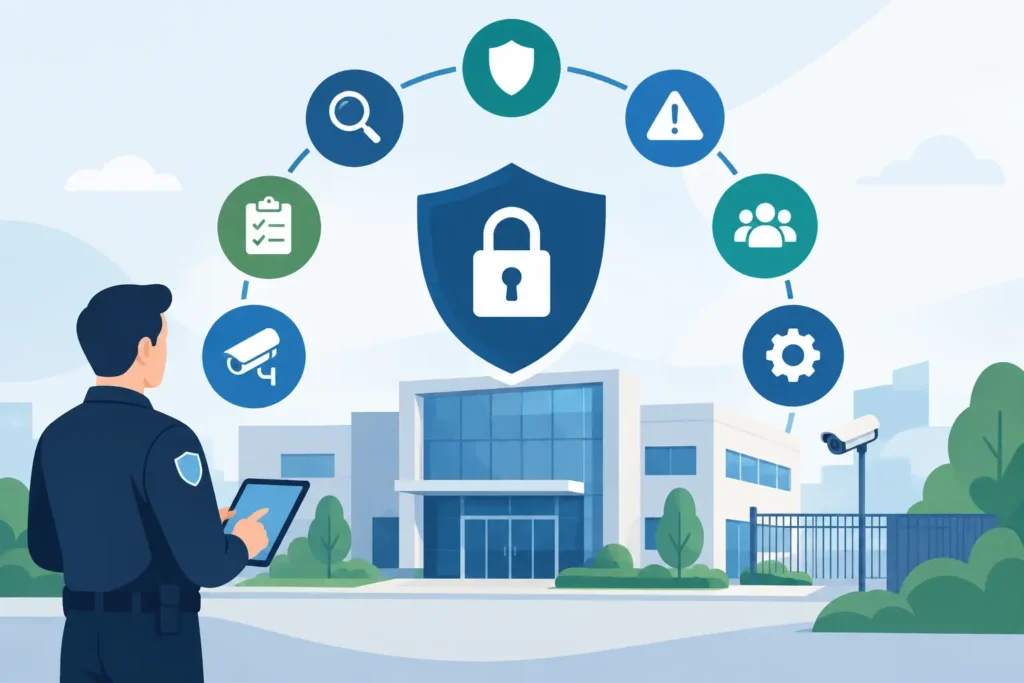
A missing delivery, a propped-open side door, or an alarm that no one sees until morning can become far more than a minor incident. These are the gaps a facility security risk management guide is designed to expose before they disrupt operations, endanger people, or create costly liability. For property owners and facility leaders, effective security begins by understanding where exposure exists, how likely it is to occur, and what response is ready when it does.
1. Define What Must Be Protected
Security planning is not just about protecting a building. It is about protecting the people, assets, information, and business activity inside it. A retail location may prioritize employee safety, loss prevention, and safe cash-handling procedures. An industrial property may be more concerned with perimeter breaches, equipment theft, hazardous areas, and unauthorized vehicle access. Offices, institutions, and multifamily properties each have different operating patterns and risks.
Start by identifying the assets that would have the greatest operational impact if they were lost, damaged, accessed, or disrupted. Include physical assets such as inventory, tools, keys, vehicles, servers, and restricted materials. Also consider less visible assets, including employee records, confidential documents, reputation, tenant trust, and the ability to open as scheduled.
This step sets priorities. A security measure that makes sense for a warehouse loading area may not address the most urgent risk at a medical office or corporate headquarters.
2. Assess Threats by Location and Time
A useful risk assessment looks beyond general concerns such as theft or trespassing. It examines how threats could occur at a particular facility. Walk the site during normal business hours, after closing, and if possible, during low-light conditions. The difference can be revealing.
Look at every approach to the property: parking lots, public entrances, rear doors, roof access points, loading docks, stairwells, gates, and shared common areas. Note blind spots, poor lighting, damaged fencing, unsecured utility rooms, and doors that employees routinely leave open for convenience. Review whether visitors can enter without being checked in and whether contractors have access beyond the areas required for their work.
Timing matters as much as location. A site may be well staffed from 8 a.m. to 5 p.m. but have no reliable response after hours. It may be vulnerable during shift changes, deliveries, special events, holidays, or periods of labor disruption. Reviewing incident history, false alarms, access records, maintenance reports, and employee concerns helps reveal recurring patterns rather than isolated events.
3. Rank Risks So Resources Go Where They Matter
Every facility has security gaps. The goal is not to eliminate every possible risk at any cost. It is to reduce the risks that are both likely and consequential to an acceptable level.
For each identified issue, consider the likelihood of occurrence and the impact if it occurs. A frequently propped door may have a high likelihood and moderate impact. Unprotected access to sensitive records may be less frequent but carry severe legal and reputational consequences. A poorly monitored loading dock could create both theft and employee-safety exposure.
Rank these findings as high, medium, or low priority. High-priority risks should receive clear controls, assigned ownership, and a defined response plan. Medium risks may require scheduled improvements or stronger procedures. Low risks still deserve documentation, especially if conditions change later.
This approach prevents a common mistake: spending heavily on visible equipment while leaving the most critical operational gaps unresolved. The right investment depends on the facility, its hours, its public access, the value of its assets, and its history of incidents.
4. Build Layers of Physical and Electronic Protection
The strongest security programs use layers. If one control fails or is bypassed, another can detect, delay, or respond to the problem. A locked door alone is not a complete security strategy. It is more effective when supported by access control, video coverage, intrusion detection, lighting, and an accountable response process.
Perimeter measures can include fencing, gates, lighting, signage, and monitored cameras. At the building level, controlled entry points, intrusion alarms, reinforced doors, and video verification add protection. Inside the facility, role-based access, secured storage, visitor management, restricted zones, and key control limit unnecessary movement.
Technology should support a clear operational purpose. High-definition cameras provide valuable visibility, but placement matters more than camera count. Coverage should identify people and vehicles where it counts, such as entrances, cash-handling areas, loading zones, and sensitive interior spaces. AI-powered video analytics can help detect events such as people entering restricted areas, loitering, or vehicles moving where they should not. However, analytics are most effective when alerts are tuned to the site and reviewed by trained personnel.
Access control offers similar advantages. It provides a record of who entered, where, and when, while allowing permissions to be changed quickly when an employee leaves, a contractor finishes work, or a restricted area needs temporary protection. For smaller sites, a well-managed smart access system may be sufficient. For larger or higher-risk facilities, integrated access, surveillance, alarms, and onsite personnel may be appropriate.
5. Plan for Detection, Verification, and Response
An alarm or camera only creates value when someone can act on the information. Facility leaders should be able to answer three questions for every critical alert: Who receives it? How is it verified? What happens next?
A monitored intrusion alarm may trigger a response after hours, while remote video monitoring can provide live visual verification before dispatching law enforcement, a guard, or a designated site contact. This can reduce unnecessary callouts and provide better information when a genuine incident is underway. It also gives decision-makers a clearer picture of events rather than relying solely on an alarm signal.
Write response procedures in plain language. Specify who contacts emergency services, who has authority to enter the site, who communicates with staff or tenants, and how evidence is preserved. For incidents involving threats, violence, or suspicious persons, employees should not be expected to investigate. Their role is to move to safety, follow established reporting procedures, and allow trained responders to take over.
For facilities with public-facing staff, after-hours answering coverage can also support continuity. A missed call may be a routine service request, but it could also be an urgent report involving an alarm, tenant, employee, or vulnerable person. The response process should distinguish between those situations quickly.
6. Make People Part of the Security System
Most security failures involve a human factor: a badge shared for convenience, a visitor escorted improperly, a door left unsecured, or suspicious activity that was noticed but never reported. Training does not need to be complicated, but it needs to be practical and repeated.
Employees should understand how to challenge or report unknown visitors, protect keys and credentials, recognize social engineering attempts, and respond to alarms or emergency notifications. Managers should know how to remove access promptly when roles change. Reception and front-line staff need clear visitor procedures that balance a welcoming environment with accountability.
Uniformed security officers can provide a visible deterrent and immediate onsite support where risk, public traffic, or operating hours warrant it. Their value is not limited to patrols. A well-briefed officer can observe unsafe conditions, manage access, document incidents, support employees, and help maintain calm during sensitive events. During labor disputes, terminations, or other heightened-risk periods, a professional protective presence can be especially valuable.
7. Test, Maintain, and Update the Plan
Security risk management is an ongoing process, not a one-time installation. Cameras can become obstructed, access permissions can accumulate, alarm devices can fail, and a facility’s risk profile can change as operations grow. Regular testing confirms that the systems and procedures you depend on will work under pressure.
Review camera views, recording retention, alarm communications, door hardware, emergency contacts, and lighting on a scheduled basis. Test whether a critical alert reaches the right people and whether they know what to do. Conduct tabletop exercises for scenarios such as a break-in, aggressive visitor, missing key, power outage, or unauthorized after-hours access.
After any incident, examine what worked and what did not. The purpose is not to assign blame. It is to improve the next response. Update procedures, retrain staff, adjust camera placement, modify access permissions, or add monitoring where the evidence supports it.
A capable security partner can help connect these moving parts through site assessments, system design, installation, monitoring, guard coverage, and ongoing maintenance. The best result is not simply more equipment. It is a security program that fits the way your facility actually operates.
Security confidence comes from preparation that holds up after the doors close. When risks are identified early, controls are matched to real conditions, and response is ready around the clock, facility leaders can protect people and operations with greater control.
