

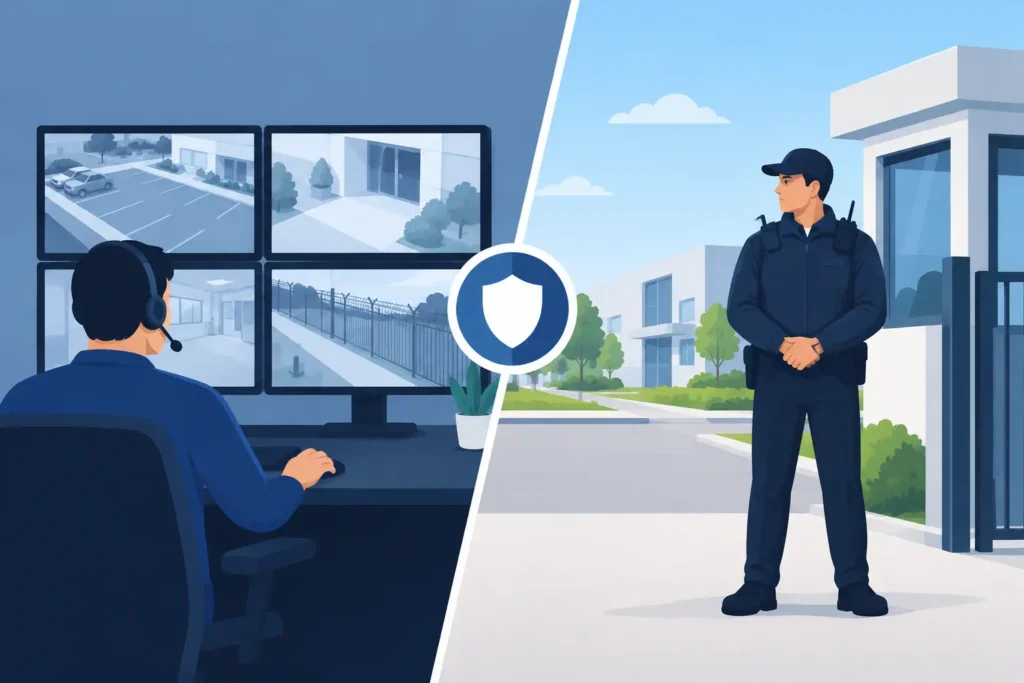
A loading dock door left open at 2:00 a.m. creates a different security problem than a disruptive customer in a busy lobby at noon. That distinction is central to remote monitoring versus onsite guards. Both services protect property, people, and operations, but they do different jobs. Choosing well starts with understanding the risk at your site, not simply selecting the lower monthly price.
Remote monitoring gives your property continuous eyes and documented visibility through cameras, alarms, and trained operators. Onsite guards provide a physical presence that can observe conditions, manage access, and respond directly within the limits of their assignment. For many businesses, the best answer is not one or the other. It is a security program that uses each where it delivers the most value.
Remote Monitoring Versus Onsite Guards: What Changes?
The practical difference is location. A remote monitoring team watches verified alarm events and video feeds from a monitoring center, while an onsite guard is physically present at your facility. That changes how each service prevents incidents, how quickly it can assess a situation, and what it can do next.
Remote monitoring is built for broad, continuous coverage. Cameras and alarm devices protect defined areas such as entrances, parking lots, warehouses, equipment yards, corridors, and perimeter lines. When activity triggers an alert, a trained operator can review live video, determine whether there is a genuine concern, follow the established response plan, and contact keyholders or emergency services when appropriate. Audio warnings may also discourage trespassers before damage or theft occurs.
An onsite guard is built for active, local control. A guard can check doors, conduct patrols, verify credentials, receive deliveries, direct visitors, document unsafe conditions, and provide a visible deterrent. In a public-facing setting, that presence can also help de-escalate conflict and give employees a clear point of contact when they need assistance.
Neither option automatically replaces the other. A camera can see a gate but cannot escort an unauthorized person from a site. A guard can patrol a building but cannot watch every entrance, remote structure, and exterior zone at the same time without supporting technology.
Where Remote Monitoring Delivers the Most Value
Remote monitoring is often a strong fit for properties that are vacant, lightly staffed after hours, spread across multiple locations, or vulnerable at predictable times. It provides 24/7 coverage without requiring one person to remain at every site overnight.
For a construction site, storage yard, or warehouse, a monitored camera system can focus attention on the areas most likely to be targeted: gates, fuel storage, tools, trailers, loading areas, and perimeter access points. Video verification helps separate real incidents from harmless motion, reducing unnecessary callouts and helping responders arrive with useful information.
Commercial offices and retail locations also benefit after closing. Rather than learning about a break-in the next morning, designated contacts can receive rapid notification once an event is verified. Recorded footage supports incident review, insurance documentation, internal investigations, and improvements to the security plan.
Remote monitoring works best when the system is designed around actual site conditions. Camera placement, lighting, network reliability, alarm coverage, signage, and escalation procedures all matter. A poorly positioned camera or an unmanaged stream of false alerts can leave a property exposed even if the equipment looks impressive on paper.
The limits to plan for
Remote operators can assess and escalate, but they are not physically at the property. Police, a mobile response unit, or a designated keyholder may still need to attend. Response times can vary by location, weather, call volume, and local emergency priorities.
Video analytics also require thoughtful configuration. AI-powered detection can help identify people, vehicles, line crossing, or loitering, but it must be calibrated for shadows, headlights, wildlife, snow, and routine activity. The goal is meaningful alerts, not constant notifications that employees begin to ignore.
When Onsite Guards Are the Better Choice
Onsite guards are most valuable when a situation requires human judgment and physical presence in real time. A guard at a hospital entrance, corporate office, retail store, event venue, or industrial facility can observe behavior, assist visitors, enforce procedures, and respond to conditions that do not always trigger a camera or alarm.
A visible guard can change behavior before an incident develops. That deterrent matters at sites facing repeated trespassing, theft, vandalism, workplace conflict, or unauthorized access. It is also important during higher-risk periods such as a labor dispute, a major event, an executive visit, or a facility shutdown.
Guards support operational continuity as well as protection. They can manage visitor logs, check contractor access, conduct scheduled patrols, secure sensitive areas, report hazards, and make sure opening and closing procedures are followed. When employees work alone or late, an onsite presence can provide reassurance and a direct path for assistance.
Presence has trade-offs
Guarding is not simply a person standing at a door. Effective service requires trained personnel, clear post orders, supervision, reliable scheduling, incident reporting, and a defined scope of authority. A guard who has not been given site-specific procedures may miss critical issues or create inconsistency for employees and visitors.
Cost is also a consideration. Around-the-clock onsite coverage usually requires multiple shifts and relief coverage. For a low-traffic facility that mainly needs after-hours protection, remote monitoring may provide more consistent coverage for the budget. Conversely, using remote monitoring alone at a site that regularly handles visitors, conflict, or controlled access can leave a gap no camera can fill.
Compare the Decision by Risk, Not Just Cost
The right choice becomes clearer when decision-makers look at what must be protected and what could happen if an incident occurs. Start with the site’s hours, layout, history of incidents, asset value, and the number of people who enter each day.
Remote monitoring is generally well suited to predictable after-hours risks, wide exterior areas, unmanned locations, and multi-site portfolios. It can extend visibility to places that would be impractical for a guard to watch continuously. It also creates a consistent record of alarm activity and responses.
Onsite guards are generally better for active locations where access must be managed, people need assistance, or immediate intervention is likely to be required. They are especially useful when security has a customer-service component or when a visible presence is part of the prevention strategy.
Consider the consequences of a delayed response. If a person entering a restricted area could create an immediate safety issue, onsite coverage may be necessary. If the primary concern is an overnight trespasser at a fenced property, verified remote monitoring with a defined response protocol may be more appropriate.
The Strongest Approach Is Often Layered Security
A layered program combines technology, monitoring, and personnel according to the risk at each location and time of day. For example, a business may use access control, monitored alarms, and AI-enabled cameras around the clock, then schedule onsite guards for opening hours, special events, or periods of increased concern.
This approach can give guards better information when they are on duty. Video coverage helps them investigate alerts, confirm conditions before entering an area, and document incidents. At the same time, guards can identify blind spots, unsafe routines, and recurring access issues that should inform system adjustments.
Maritect Investigations & Security Limited designs integrated programs around these practical handoffs. The objective is not to add technology or personnel for its own sake. It is to create reliable coverage, clear response procedures, and accountability from the first alert through final reporting.
Questions to Ask Before You Decide
Before selecting remote monitoring, onsite guards, or a combination, clarify who needs access, when the property is most vulnerable, and what response is expected after an alert. Confirm whether your system can provide usable video at night, whether alarms are verified before escalation, and who has authority to make decisions after hours.
For guard services, ask how post orders will be developed, how patrol activity and incidents will be documented, what training is relevant to your environment, and how staffing coverage will be maintained. For either option, establish a simple communication plan for managers, employees, emergency contacts, and responders.
Security is most effective when it reflects the way your property actually operates. A carefully monitored yard may not need a full-time guard. A busy facility with controlled access may need more than cameras. Start with the risks that matter most, then build coverage that keeps your people, assets, and operations protected with confidence.
