

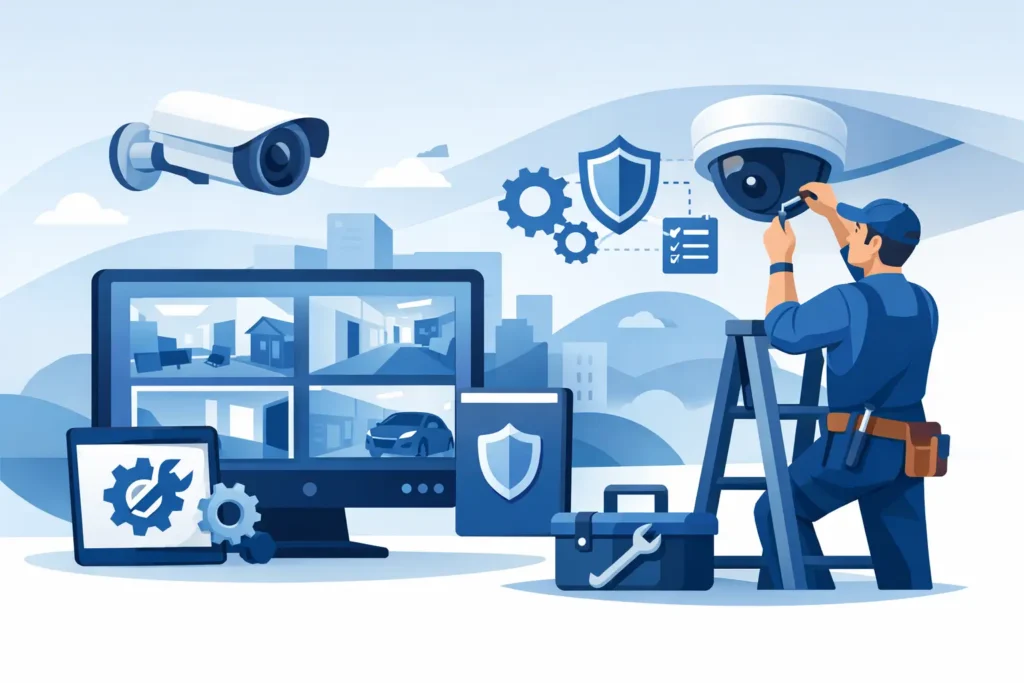
A camera that records a blurred loading dock, misses a person at the perimeter, or stops saving footage after an incident is not providing the protection you paid for. Security camera system maintenance keeps every component ready to deliver clear video, timely alerts, and usable evidence when it matters most.
For property owners and operations teams, maintenance is not simply a technical task. It is part of business continuity. A well-maintained system helps reduce blind spots, supports investigations, verifies alarm events, and gives staff a dependable view of what is happening across the property. A neglected system can create false confidence – cameras may appear to be operating while recording gaps, storage failures, or poor image quality quietly undermine coverage.
Why security camera system maintenance is operationally critical
Surveillance systems work as a chain. Cameras capture images, network equipment moves the data, recorders or cloud services store it, analytics identify activity, and monitoring teams or designated staff respond. A problem at any point can weaken the entire system.
Consider a retail site where a camera lens is coated in road dust and salt, a common challenge near busy streets and coastal environments. The camera may still show a live image, but facial details, license plates, and activity near the entrance can be difficult to verify. Or consider an office where a network switch intermittently drops a group of cameras. Unless someone checks recording status and retention, the issue may not become visible until footage is needed.
Routine care turns these unknowns into controlled, documented checks. It confirms that cameras are online, views remain useful, timestamps are accurate, recordings can be retrieved, and critical alerts reach the right people. It also creates a service record that helps facilities managers track recurring issues and plan upgrades before failure affects protection.
What a complete maintenance visit should cover
A meaningful service program looks beyond wiping camera housings. The right scope depends on the site, camera count, environmental exposure, retention requirements, and whether the system includes AI analytics, access control, alarms, or 24/7 remote monitoring. Still, several areas deserve consistent attention.
Camera condition and image quality
Technicians should inspect camera housings, mounts, connectors, cables, and visible signs of tampering or weather damage. Loose mounts can gradually change a camera’s field of view. Condensation inside a dome, glare from a newly installed exterior light, or vegetation growing into a scene can make otherwise reliable equipment ineffective.
Lenses and protective covers need appropriate cleaning, particularly for exterior cameras exposed to rain, pollen, salt, insects, exhaust, and snow. The goal is not only a clean-looking image. It is to confirm that the image is sharp enough for the system’s purpose, whether that means observing a doorway, identifying a person, reading activity at a gate, or monitoring a large parking area.
Night performance requires its own check. Infrared illumination, low-light settings, reflections from nearby surfaces, and changing site lighting can all affect visibility after dark. A camera positioned correctly during the day may produce washed-out or shadowed video at night.
Recording, retention, and evidence retrieval
A live view does not prove that recordings are being saved correctly. Maintenance should verify that each required camera is recording, that video is stored for the agreed retention period, and that available storage has not been consumed by unnecessary settings or recording errors.
Technicians should also retrieve sample footage from different cameras and dates. This tests playback quality, export capability, timestamps, and the ability to locate an event efficiently. When an incident occurs, teams should not be learning for the first time that a recorder is full, the date is wrong, or exported video cannot be accessed by investigators.
Retention needs vary. A small office may require a different retention period than an industrial site, a multi-tenant property, or a facility handling sensitive inventory. The right setting balances risk, policy requirements, available storage, and budget. More retention is not automatically better if it reduces image quality or creates unnecessary storage costs.
Network, power, and cybersecurity checks
Modern IP cameras rely on stable network connections and power. During maintenance, the system should be checked for offline cameras, bandwidth constraints, damaged cabling, switch health, backup power status, and recurring connection faults. A camera that disconnects for short periods can create footage gaps even if it appears online during a quick walkthrough.
Cybersecurity belongs in the same conversation. Cameras, recorders, and connected applications should use controlled access, current firmware where appropriate, strong credentials, and segmented networks when the site design calls for it. Remote access is valuable for managers and monitoring teams, but it should be configured carefully rather than left open for convenience.
Firmware updates involve a trade-off. Updates can resolve known issues and improve stability, but they should be reviewed, scheduled, and tested to avoid unexpected compatibility problems. For sites that operate around the clock, maintenance windows and rollback planning matter.
Analytics, alerts, and integrations
AI-powered video analytics can reduce nuisance notifications by distinguishing people, vehicles, and relevant activity from routine movement. But analytics must be maintained as conditions change. A relocated dumpster, new fencing, seasonal foliage, or construction activity can affect detection zones and alert accuracy.
A maintenance review should test event rules, camera health alerts, notification paths, and escalation contacts. If an alarm system, access control platform, intercom, or remote monitoring service is integrated with video, the full response workflow should be tested. The question is not only, “Did the alert trigger?” It is, “Did the right person receive enough information to act quickly?”
Set a maintenance schedule around risk, not convenience
There is no single inspection interval that fits every property. A lightly used indoor office system may need a formal professional review annually, supported by regular internal checks. A high-traffic retail location, construction site, industrial yard, or exposed exterior property may need more frequent service because lenses, mounts, lighting, and environmental conditions change faster.
A practical approach is to assign simple ownership. Site staff can complete brief monthly visual checks: confirm cameras are not blocked, verify that key views look normal, and report damage immediately. Professional technicians can perform scheduled deeper inspections, recording tests, firmware reviews, network diagnostics, and calibration work.
After severe weather, a break-in attempt, electrical disruption, renovation, or network change, do not wait for the next scheduled visit. These events can alter coverage or create hidden faults. A targeted inspection is usually less costly than discovering a problem during an investigation.
Signs your surveillance system needs attention now
Some issues justify prompt service rather than routine follow-up. Repeated camera offline notices, pixelated or dark video, drifting timestamps, noisy false alerts, recorder storage warnings, and slow footage retrieval all deserve investigation. So do cameras that show a live image but have no recent recordings.
Operational changes can be just as significant as technical alarms. If your facility has added a new entrance, changed traffic flow, expanded a parking area, installed exterior lighting, or moved valuable assets, the original camera design may no longer match the risk. Maintenance is a good time to reassess camera placement and make sure coverage supports current operations.
Documentation turns maintenance into accountability
Every service visit should leave behind a clear record of what was inspected, what was corrected, what still requires attention, and any recommended improvements. This gives decision-makers a reliable view of system condition instead of a vague assurance that everything was checked.
For multi-site organizations, documentation also supports consistency. It helps identify patterns, such as a camera model that repeatedly fails in a specific environment or a location where alert settings require adjustment. Over time, those insights inform smarter budgets and better security planning.
Maritect Investigations & Security Limited approaches maintenance as part of an integrated protection program, connecting camera performance with monitoring, alarms, access control, and the human response required when an event occurs.
Make maintenance part of your response plan
The best time to verify footage, alerts, and system health is before an incident tests them. Treat surveillance maintenance as a standing operational requirement, with clear service intervals, responsible contacts, and a defined process for urgent faults. That preparation gives your team more than working cameras – it gives them reliable visibility when quick, confident decisions are required.
