

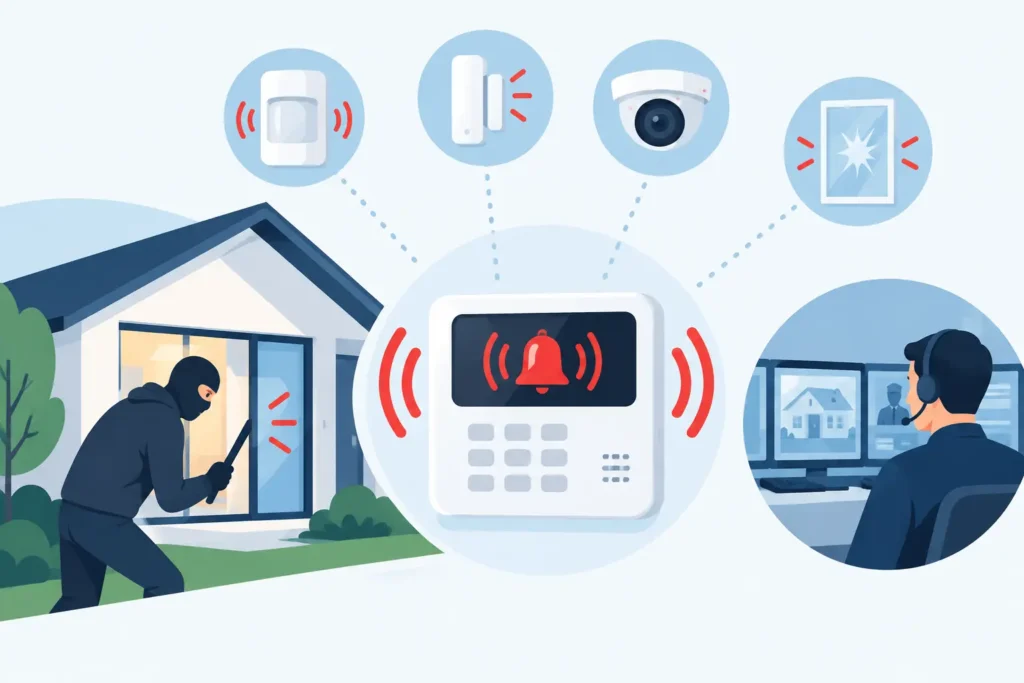
A security system can detect an event in seconds, but the response that follows depends on more than a siren sounding. Understanding what triggers security alarm response helps property owners and operators set realistic expectations, reduce false alarms, and ensure the right people are notified when a real threat occurs.
For a retail store, office, warehouse, residence, or institution, an alarm should not simply create noise. It should begin a documented response process designed around the property, the risk, and the people who may be affected.
What Triggers a Security Alarm Response?
A security alarm response begins when a connected device detects activity or a condition that matches its programmed alarm criteria. The trigger may come from an intrusion sensor, a door contact, a panic button, a monitored camera, or an environmental device. Once received, the alarm system sends a signal through its available communication path, such as cellular, internet, or a backup connection, to the monitoring platform or designated contacts.
The event itself is only the first step. A professionally managed response may involve signal review, video verification, contact notification, guard dispatch, and, when appropriate, notification to emergency services. The exact sequence should be established before an incident occurs, not improvised after an alarm goes off.
Intrusion and unauthorized-entry alarms
Unauthorized entry is one of the most common alarm triggers. Door and window contacts activate when a secured opening is opened while the system is armed. Motion detectors can activate when movement occurs within a protected area. Glass-break sensors may respond to the sound pattern created by breaking glass, while vibration or shock sensors can detect force against a door, window, or other vulnerable surface.
These devices work best when they are selected and positioned for the building. A warehouse with overhead doors, a retail location with public-facing glass, and a residence with pets all require different sensor choices and settings. A sensor that is too sensitive can create false alarms. One that is poorly placed may leave a critical area unprotected.
Alarm triggers from access control systems
Access control can also create an alarm event. A forced-door alarm occurs when a door opens without a valid credential or authorization. A door-held-open alarm can activate when someone props open a controlled entrance beyond the allowed time. Repeated denied-card attempts, access outside approved hours, or a credential used at an unusual location may also require review.
For facilities managers, these events provide more than a notification. They establish accountability. A well-integrated system can connect the door event with camera footage, user records, and a time-stamped incident log, allowing the response team to assess what happened quickly.
Panic, duress, and personal safety signals
Panic buttons and duress devices are designed for situations where someone needs immediate help. They may be placed at reception desks, cash-handling areas, medical offices, schools, executive locations, or isolated workstations. Unlike a typical intrusion alarm, a duress signal is often silent so it does not escalate the situation or alert the person causing concern.
These signals need clear response instructions. Monitoring personnel must know whether to contact emergency services, alert onsite security, notify a manager, or follow a site-specific emergency procedure. Employees should also understand when and how to use the device. A panic button is most effective when the technology, training, and response plan work together.
Video analytics and AI-detected activity
Modern video surveillance can identify activity that traditional alarm devices may miss. AI-enabled analytics can be configured to detect people entering restricted zones, vehicles arriving after hours, loitering near an entrance, perimeter crossings, object removal, or activity around high-value assets.
This does not mean every person seen on camera should trigger a full alarm response. The value of video analytics is in setting meaningful rules. For example, a person walking through an employee-only loading area at 2:00 a.m. may require immediate review, while normal daytime delivery activity may not. Proper configuration reduces unnecessary alerts while improving awareness of genuine risk.
Environmental and equipment conditions
Some monitored systems also respond to conditions that threaten property or operations rather than indicate a crime. Water leaks, temperature changes, power failures, freezer alarms, smoke detection, carbon monoxide alerts, and equipment tampering can all generate a response.
For organizations with server rooms, sensitive inventory, medical supplies, or refrigerated products, these alerts can prevent expensive losses. The right response may be a maintenance contact rather than emergency dispatch, but speed still matters. A temperature alert that sits unnoticed overnight can become a business interruption by morning.
What Happens After an Alarm Is Triggered?
An alarm signal does not automatically mean police, fire, or emergency personnel are dispatched. Response procedures vary by alarm type, monitoring agreement, local requirements, and the information available at the time. This is why a customized security plan matters.
When a monitored alarm is received, the monitoring team first identifies the account, event type, location, and designated instructions. If video verification is available, trained personnel may review live or recorded footage to determine whether there is visible evidence of intrusion, suspicious activity, or another concern. They may also attempt to contact authorized keyholders when the procedure calls for it.
Verified information can help determine the next action. Depending on the event, that may include notifying a property owner, sending a mobile patrol or uniformed guard, contacting emergency services, or escalating to an onsite manager. A guard response can be particularly valuable when a site needs a physical check, a visible security presence, or documented observations after hours.
The response plan should account for practical realities. A residential alarm may prioritize calling the homeowner and emergency services. A commercial site may require notification to a facilities manager, a guard dispatch, and a review of camera footage before additional action. A high-risk facility may have a stricter escalation path with multiple contacts and immediate protective measures.
Why False Alarms Still Need Attention
False alarms are not harmless. They can disrupt operations, create unnecessary stress, consume response resources, and in some jurisdictions lead to fines or permit issues. More importantly, repeated false alarms can cause people to become complacent, which is dangerous when a real incident occurs.
Common causes include employees entering with the wrong code, doors not closing properly, low sensor batteries, pets moving through protected areas, construction dust, unsecured windows, and outdated contact lists. Poorly maintained equipment can also create communication failures or unreliable signals.
Reducing false alarms requires more than turning down sensitivity. Systems should be tested regularly, users should be trained on arming and disarming procedures, and contacts should be updated whenever staffing or responsibilities change. Video verification and integrated access control can add useful context, helping teams distinguish a routine issue from an event that demands immediate action.
Building a Response Plan That Fits Your Site
The strongest security programs are designed around risk, not generic equipment packages. Start by identifying what must be protected: people, entrances, inventory, equipment, data, vehicles, or sensitive areas. Then consider when the site is most vulnerable. A busy office may need after-hours intrusion detection, while a distribution facility may need perimeter monitoring and loading-dock coverage around the clock.
Your plan should define alarm priorities, emergency contacts, guard-response expectations, camera-review procedures, and escalation rules. It should also identify who has authority to cancel an alarm, who receives reports, and how incidents are documented. These details matter when a keyholder is unreachable or an event occurs outside normal business hours.
Maritect Investigations & Security Limited designs integrated programs that connect alarms, surveillance, access control, remote monitoring, and protective services into a coordinated response. That approach gives decision-makers clearer visibility and a reliable path from detection to action.
A security alarm should give you more than an alert on a phone. With the right design, maintenance, and response procedures, it gives your property a dependable way to call for attention when attention is needed most.
