

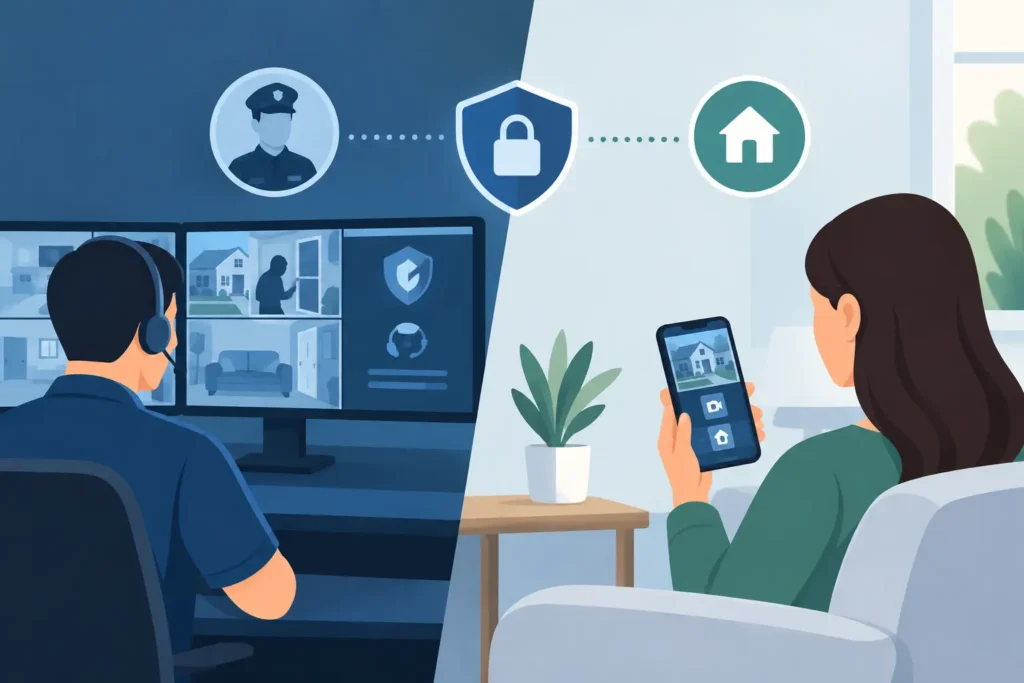
A break-in alert at 2:14 a.m. creates one immediate question: who is going to see it, decide what it means, and act on it? That is the real difference in monitored alarms versus self monitoring. Both can notify you when a door opens, a motion detector trips, or a camera detects activity. The better choice depends on whether you can reliably take action every time an alert arrives.
For a homeowner, that may mean responding while away on vacation or in a meeting. For a business operator or facilities manager, it may mean protecting a site after staff have gone home, when no one is available to review a notification. Security is not only about receiving information. It is about having a dependable response when an incident cannot wait.
What self-monitoring means in practice
Self-monitoring sends alarm, camera, or smart-device notifications directly to a property owner, manager, or designated employee. You may receive an app notification, text message, phone call, email, or live video clip when the system detects activity. From there, the responsibility is yours: review the event, contact someone at the property, call law enforcement if necessary, or decide that the alert is not a concern.
This model can work well for lower-risk settings and owners who are consistently available. A resident may be comfortable checking a front-door camera after an alert. A small office with predictable hours may assign a manager to review events during evenings and weekends. Self-monitoring also gives users direct visibility and control, particularly when paired with cameras, smart locks, and environmental sensors.
The trade-off is coverage. Notifications can arrive while you are driving, sleeping, in a flight, managing a customer issue, or simply away from your phone. A business may assign several people to receive alerts, but those contacts can change jobs, miss calls, or assume somebody else is handling the situation. The system may be working exactly as designed, yet the response process can still fail.
False alerts are another practical concern. A motion event might be caused by weather, an employee entering early, a delivery vehicle, or a camera analytics setting that needs adjustment. If alerts happen frequently, people can become less likely to review them promptly. Self-monitoring is most effective when the system is properly designed, notifications are meaningful, and there is a clear plan for who responds.
How professionally monitored alarms work
With professional monitoring, an alarm signal is sent to a monitoring center staffed around the clock. Trained operators follow established procedures to assess the signal, contact designated keyholders, and request emergency response when the situation meets the required criteria. Procedures vary by system type, customer instructions, verification capabilities, and local emergency-response policies.
The core benefit is continuity. A monitored alarm does not depend on the owner seeing a phone alert at the right moment. If a burglary alarm, panic device, fire signal, low-temperature alert, or other monitored condition is triggered, the monitoring process continues whether your team is in the office, at home, or unavailable.
For many commercial properties, the response chain is as valuable as the alarm itself. A professionally managed setup can include current contact lists, escalation instructions, site details, access information, and documented actions. This helps reduce confusion during an after-hours event and gives managers an accountable record of what happened and when.
Monitoring is not a guarantee that an incident will be prevented or that emergency services will arrive within a specific timeframe. It is a structured response service designed to make sure critical signals are not left waiting in an unread notification queue. That distinction matters when evaluating security risk.
Monitored alarms versus self monitoring: the operational difference
The most useful comparison is not technology versus technology. Modern alarm panels, cameras, sensors, and mobile apps can support either approach. The difference is who owns the responsibility for recognizing an event and moving it forward.
Self-monitoring places the responsibility with you or your team. This can be appropriate when the consequences of a missed alert are limited and an informed person is genuinely available to respond. It can also serve as a useful layer alongside professionally monitored intrusion protection. For example, a manager may receive video alerts for awareness while a monitored alarm handles urgent after-hours signals.
Professional monitoring shifts first-level response to a dedicated service. It is often the stronger fit where downtime, theft, safety concerns, or unauthorized entry could create serious consequences. Retail locations, warehouses, offices with sensitive records, construction sites, multi-unit properties, institutions, and remote facilities often need more than an app notification. They need consistent coverage after hours and a plan that does not rely on one person being reachable.
The right choice can also vary across one organization. A main office may require monitored intrusion and life-safety devices, while a low-risk storage area uses self-monitored cameras for occasional activity. A layered program lets you direct resources toward the areas where a delayed response would have the greatest impact.
Cost should include the cost of a missed event
Self-monitoring usually has lower ongoing costs because there is no 24/7 monitoring service fee. For some properties, that makes it an attractive and sensible option. However, the purchase price or monthly fee should not be the only comparison.
Consider what happens if an alarm is missed. The resulting cost can include stolen inventory, damaged doors or equipment, business interruption, lost data, employee safety concerns, insurance issues, and time spent managing the aftermath. A single unaddressed incident can outweigh years of monitoring fees.
Professional monitoring adds a recurring expense, but it also provides a defined service model. For businesses, that can reduce dependence on employees who are not security professionals and may not be available outside their scheduled hours. It also supports better accountability: there is a documented process rather than an informal expectation that someone will answer their phone.
Cost should also account for system maintenance. Sensors, batteries, communication paths, camera views, user permissions, and contact lists all need periodic attention. A security program performs best when it is reviewed as operations change. New staff, altered hours, expanded facilities, and changing inventory levels can all affect the response plan.
Response speed depends on preparation
An alarm is only useful if the signal reaches the right person through a working communication path. Cellular or dual-path communication can provide stronger reliability than a system that depends only on a single internet connection. Backup power, tamper protection, properly placed devices, and routine testing also affect whether an alarm can report an event when conditions are difficult.
Preparation also means reducing unnecessary alarms. Clearly defined arming procedures, employee training, proper sensor placement, and tailored camera analytics can help limit false dispatches and alert fatigue. The goal is not to create more notifications. It is to produce useful signals that lead to appropriate action.
For facilities with higher risk, integrating alarms with video verification, access control, and onsite security procedures can provide a clearer picture of what is happening. An access event after hours, followed by a door alarm and camera activity, carries more context than any single alert on its own. This is where a customized security design can make day-to-day protection more dependable.
Questions to ask before choosing
Start with your risk, not the equipment catalog. Ask who is responsible for responding after hours, how quickly they can get involved, and what happens if they are unavailable. Consider whether the property holds cash, inventory, sensitive information, tools, medications, or equipment that would be costly to lose or damage.
Also consider the people affected by an incident. A missed alert at an empty storage unit is different from a panic alarm at a reception desk, unauthorized access to an occupied facility, or a break-in at a residence while family members are asleep. Higher consequences generally call for a more formal monitoring and response process.
Finally, review your current system honestly. If alerts are ignored, contact lists are outdated, cameras have blind spots, or staff do not know how to arm and disarm the system, adding more devices will not solve the underlying problem. The system and the response plan need to work together.
Maritect Investigations & Security Limited helps property owners and organizations build security programs around their actual risks, from alarm installation and remote monitoring to AI-enabled video, access control, and protective services. The objective is practical: clear visibility, reliable response, and protection that continues when you cannot be on site.
The best security choice is the one that still works on your busiest day, your worst night, and the moment no one is available to check a phone.
